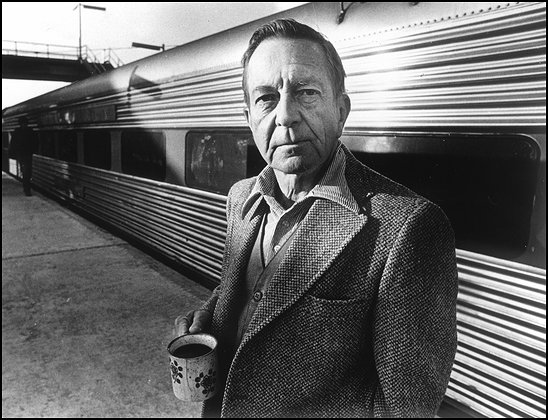
In his story Reunion, John Cheever breaks up a relationship in fewer words than it can take to write a book report. The story was published in 1962 and tells the reader about a college student, Charlie, who encounters his father, a person he never met consensually during a minute-long stop at the Grand Central Station. Trying to pass off what should count as a heartwarming reunion, it turns out into a wretched journey through all sorts of restaurants Manhattan has to offer, with a generous dose of classism and secondhand embarrassment to spare.
Our narrator, Charlie, is on his way to his grandmother funeral then he sees his father in the Grand Central. They have not seen each other in three years which should have been a red flag the size of the Soviet parade banner. A “big, good-looking man” the father, does not hesitate and proposes to have lunch during an hour-and-a-half layover of Charlie.
What ensues is a restaurant-skipping nightmare that Gordon Ramsay would have cried over. What the father does gets even more embarrassing to downright humiliating when he:
Cheever is not merely recounting a lousy lunch date but he is examining the hierarchy within the American society and the American mythology of fatherhood. The fact that the father is extremely violent against his service workers is a sign of his lack of security and the need to show his power, whereas the mortification displayed by Charlie is an indication that he is getting to learn more and more about the flaws of his father.
The story operates on multiple levels:
Years after, Charlie narrates the story causing the drama of irony. The grown up narrator realizes that what his younger self did not, that this reunion was not successful to begin with.
The more he takes his turn to visit the restaurants, the worse it becomes, until the last one where Charlie finds that his dad is not the man he had hoped he was.
Grand Central turns into an allegory of life transitions and temporary links. The endless motion reflects the emotional range of Charlie as he goes from hopeful expectancy to disillusionment.
Charlie simply says that he went to the train and this ends the story. And this low-key finish is powerful- poetry sometimes needs no words in order to be the most tragic. It literally drops a mic in literature, but with many more psychological consequences.
When analyzing “Reunion,” consider how Cheever uses:
To aid literary analysis of works extensively, websites such as StudyCreek can be used to provide an in-depth walkthrough of short story analysis. Students who demand specialized research support may visit DissertationHive, although other academic support options are offered by StudyCorgi, EssayPro, EssayShark, and Edusson.
The short film Reunion demonstrates that the strongest stories are not always made of what does transpire in life–the relation that is not re-established, the sire who is not reformed and the encounter that turns out to be a farewell.
Sample Assignment:
My assignment is to do a Plot Summary Writing/Short story on John Cheever’s “Reunion”.
I need 5 paragraphs. 7 sentences for each paragraph…
1. Intro
2. Rising Action
3. Climax
4. Falling Action
5. Resolution
Sample Answer:
A Plot Summary of John Cheever’s “Reunion”
Name:
[Your Full Name]
Course:
[Course Title]
Instructor:
[Instructor’s Name]
Date:
[Month Day, Year]
In his short story Reunion, John Cheever depicts a rather brief but intense encounter between a boy and his abandoned father. The son, Charlie, does the narration, and this narration captures the aspect of expectations, disappointment, and disillusionment. Charlie is eager to meet with his father on a stopover at New York City. His tone is full of excitement similar to that expressed by a desire to connect and feeling of paternal love. Cheever even takes a promise of the reunion and frays that hope collaboratively through the actions of the father. Cheever creates an emotional story in a few pages using accurate and economical story telling. It is a narrative of a sequence of exchanges with more emotional truth manifesting.
The rising action commences with Charlie meeting his dad at the Grand Central Station. Charlie is initially amazed by the charisma and charm of his father. His father is in a suit, a confident male who starts guiding Charlie right away through the crowded streets of New York. He makes a promise to his son that he will take him to lunch and they start visiting restaurants. But every time they are thrown out by the rude and aggressive conduct of the father. This cycle is repeated severally and it makes Charlie feel more uncomfortable and confused. The difference between the optimistic expectations of the child Charlie and the reality of the actions of his own father starts escalating. The tension is subtle and gradually grows since the reader discovers the shortcomings of the father.
The highlight of the tale is when both Charlie and his father are thrown out of yet another restaurant. This time the offending of the father is at its most aggressive, with him insulting staff with filthy and degrading language. Charlie, who is barely polite and restrained, sees his father acting irresponsibly. It is also at this point that an interior transformation in Charlie comes into view he is starting to perceive his father not as a person who can be admired, but as a man who is excessively flawed, and embarrassing. It is also the place where the emotional strain is the closest when Charlie is quietly digesting his disappointment. It is this point of turning that shows the full strength of the emotional core of the story. The delusion of reuniting is contested. That is a tense and weak relationship that breaks down because of his unrealized expectations.
Soon enough the falling action ensues, as it becomes clear to Charlie that there will be no significant bond to emerge out of this encounter. His father is still being inconsiderate without knowing the harm he is inflicting. Charlie, however, has hardly a word to say– his silence revealing more than words could have done–being at once a witness of shock and an indication of his progressive detachment. As they walk through the streets, Charlie is no longer excited or hopeful. The bonding that his father showed now appears empty and superficial. The setting is changed from active to somber. The tension gradually dissolves into resignation. This marks a moment of emotional withdrawal for Charlie.
In the resolution, Charlie ends the visit by quietly saying goodbye and heading back to his train. No dramatic confrontation, no heart-rending conclusion, there is a quiet parting. The final stage of the story sees Cheever leaving us with Charlie revisiting that very day as the last time he is seeing his father (Cheever, 2000). It is emotional due to its simplicity. This reunion reconciliation was brief and yet its impact remained on the narrator. This small meeting helps Charlie to grow up, to learn how to look at his father without an illusion. Reunion eventually depicts suffering of futile expectations and loss of innocence. The last lines of the story are filled with a sealing effect, though father and son do not reach any kind of reconciliation.
References
Cheever, J. (2000). Reunion. In The Stories of John Cheever (pp. 250–252). Vintage International.
Delivering a high-quality product at a reasonable price is not enough anymore.
That’s why we have developed 5 beneficial guarantees that will make your experience with our service enjoyable, easy, and safe.
You have to be 100% sure of the quality of your product to give a money-back guarantee. This describes us perfectly. Make sure that this guarantee is totally transparent.
Read moreEach paper is composed from scratch, according to your instructions. It is then checked by our plagiarism-detection software. There is no gap where plagiarism could squeeze in.
Read moreThanks to our free revisions, there is no way for you to be unsatisfied. We will work on your paper until you are completely happy with the result.
Read moreYour email is safe, as we store it according to international data protection rules. Your bank details are secure, as we use only reliable payment systems.
Read moreBy sending us your money, you buy the service we provide. Check out our terms and conditions if you prefer business talks to be laid out in official language.
Read more