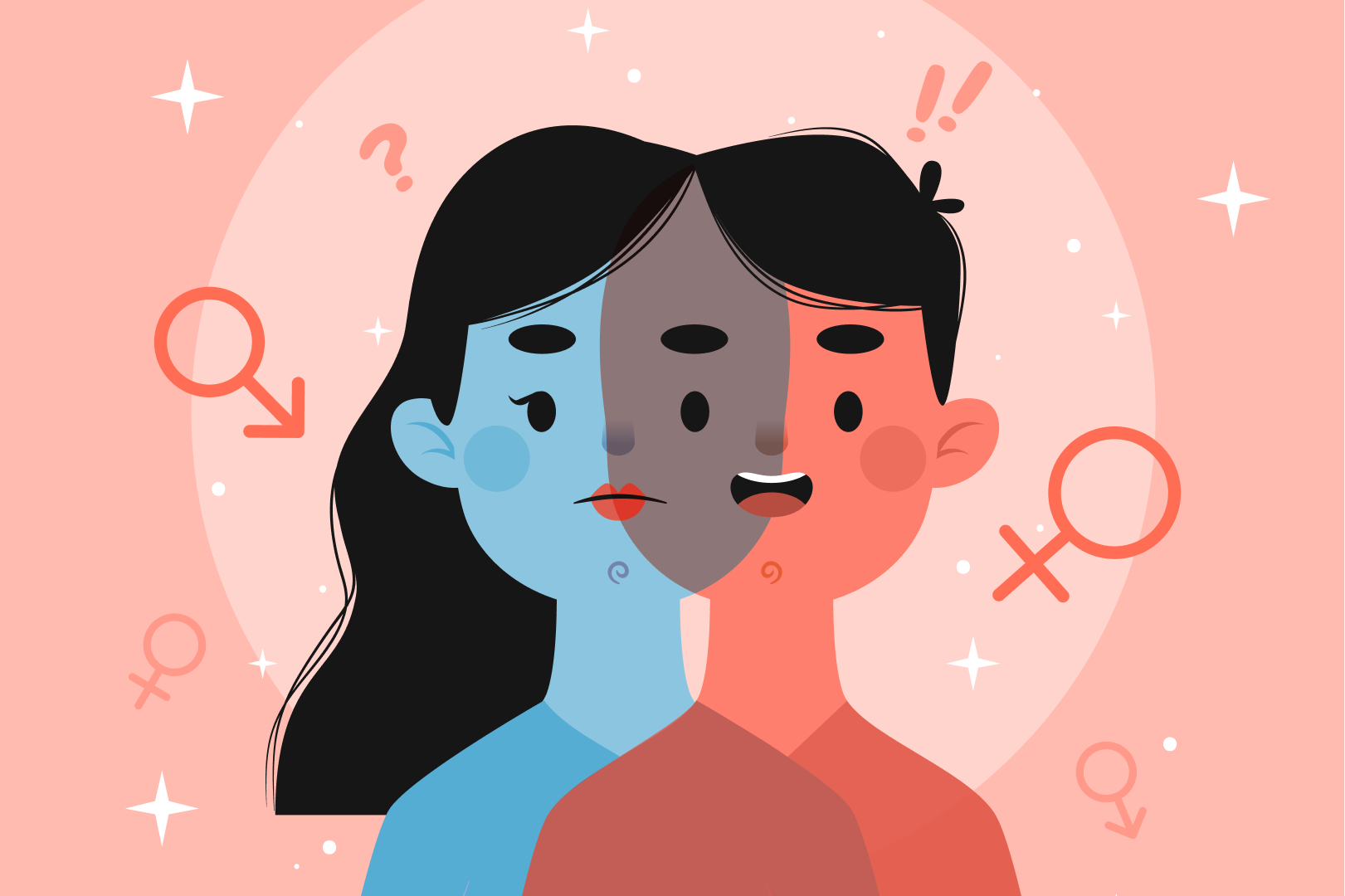
In case they came to Earth and attempted to learn all they could about human gender by observing the aisles of the toy store, I think aliens would have determined that half of our gender is genetically programmed to adore glitter and the other half must be biologically destined to form a cacophony of noises. And here we have the lovely clash of nature and nurture and human propensity to color chromosomes.
Childhood experiences as the greatest social experiment in human history in which every interaction, whether subtle (or not so subtle), sets expectations on the meaning of gender roles. At baby showers every time it is announced “It’s a princess!” into playground politics that mysteriously separate children according to mysterious rules, childhood becomes a constant gender training course that renders university programs a child’s play.
Studies have repeatedly shown that girls and boys adopt gender norms, and that in terms of delayed maturity, before learning how to correctly tie a pair of shoes or sustain their memory on where they left their homework, they can already adopt gender norms. These patterns are unconsciously perpetuated by parents, teachers and peers, through the choice of toys, through behavioral norms. It is a bit like learning a second language where there is a culture to speak the language and nobody acknowledges trying to teach it.
The influence goes beyond the superficial tastes. Research reveals that gender socialization at a young age affects future careers, taking risks, emotional displays, and interaction with others. This would form mental constructs that would either open up or narrow the horizons of life around these early experiences these would be the walls or bridges that were coming into existence in the personality without any real wall or bridge being in existence–in other words, build invisible structures that would be an index to life courses.
Gender roles are invisible job descriptions that no one created, but everyone seems to get by heart. These forms of social scripts are able to restrict human potential in overt and also implicit ways, to create false boundaries in everything such as career choices to expressing emotions.
Occupational practices continue to struggle with gendered expectations, such that some professions are like initiation clubs with unwarranted adhesion rules. Equally, at home roles tend to follow gender lines, which are sometimes disregard to personal choice or suitability. It is as though you want to improvise rather than read a script, but everyone keeps telling you that you should follow the script just like in a play.
This impediment has not only cost individuals, but it symbolizes a societal loss in efficiency by failing to utilize undiscovered talents and vision that may never be heard due to not conforming to the preconceived notions of the traditional gender definitions.
The nature/nurture argument in gender research is like a complex game of chess with rules being changed in the middle of the game. Where biological distinctions exist between men and women based on scientific evidence, their cultural meanings depend on the society and historical era to which they belong to, but differ radically.
There are societies that have more than two genders yet others adhere to a strict duality. These differences imply that although biology forms the scaffold, culture forms the building- and architectural styles differ significantly among human civilizations.
Modern studies are gradually indicating that gender identity is the cumulative effect of biological inclinations, hormonal factors, brain making, and societal programming. Rather than being biology versus culture it is more about realizing how the dances together in the construction of human identity.
Literature students examining gender themes in texts can find comprehensive research support through StudyCreek, which specializes in gender studies and literary analysis. For advanced research on gender theory and cultural analysis, DissertationHive offers expert guidance on complex interdisciplinary topics.
One can also find more academic writing help at StudyCorgi, EssayPro, EssayShark, and Edusson—which are great sources of information on the analysis of gender issues in literature and culture by a student.
Gender cannot be made sense of without accepting it to be as intimate as it is societal; as nuanced as a meeting place between personal identity, and the individual cultural demand to fulfill that identity, to a tale as individualized as humans are.
Sample Assignment:
In 550 words, please make sure you write a well-organized and critical reaction to my question(s) below.
You will discuss the question “how do we ‘become’ boys and girls?” using firsthand experience to illustrate, as well as offering any insight you have into the question.
Think, for example, about what experiences, toys, activities shaped you as a young person in terms of gender. Do any experiences NOT shape our understanding of gender in some way?
Did you experience any limitations because of your gender?
How does culture influence gender?
What is a “gender role?” Where do we learn them?
To what extent does culture influence human biology?
Sample Answer:
Becoming Boys and Girls: A Critical Reflection on Gender Identity and Cultural Influence
[Course]
Instructor: [Instructor’s Name]
Student Name: [Your Full Name]
Date: [Insert Date Here]
The issue of how we turn into boys and girls is much deeper than biological sex and ventures into the unknown territory of culture, experience, and socialization. I was socialized to be a girl since my early childhood days through layers of innuendo and direct messages on what being a girl encompassed. My toys were light in color–dolls, miniature kitchen sets, and role playing clothes; my male cousins got action figures, cars, and building sets. These distinctions though innocent enough made a clear impression on who does what and the establishment of early childhood thoughts of gender roles and gender expectations.
Gender roles refers to the behavior, tasks and duties that society considers that men and women should perform. Family, media, school and peers teach us these roles. Even girls at a young age where told to sit like a lady, be gentle and not to be too loud whereas boys were to be tough, assertive and risk-takers. These messages informed me, defined who I was, what I did and even what I desired to do career wise. I started wondering why science and leadership are in many respects a male-dominated arena only when I was in high school.
Culture is an important factor in the assimilation of gender. According to Judith Butler, gender is performative- a reiteration of acts that are governed by societal cultures (Butler 25). I recall school plays when girls would always be princesses or caretakers and boys heroes or adventurers. Such functions were never discussed they were anticipated. Even television reaffirmed the stereotype: such shows as Barney or Sesame Street depicted cooperative and caring female characters and adventurous and problem-solving male ones.
I had limitations with respect to gender despite the progress. At one point I also had an interest to attend a coding club, but was discouraged by one of the teacher by saying, that it is full of boys, and it might not be enjoyable to me. On the face of it, that moment was nothing more that, but it did leave the footprint on me as it marked that there were places I was not supposed to feel welcome. Elements like confidence, interests and social belonging tend to be gendered. Not every experience can solidify gender roles of course; but, even without specific teaching, lack of instruction effectively can influence behavior. As an example, the absence of female characters in STEM or managerial jobs preconditioned the idea that both spheres are less available, which remains unconscious.
Culture also meets human biology. Although the biological sex is assigned during birth, the meaning and expression of such sex is highly determined by the societal norms. The work of Margaret Mead in Samoa, and in Papua New Guinea highlighted how gender roles differ across cultures, and therefore, it appeared that biology did not pigeonhole behavior very rigidly (Mead 1949). We are not born knowing how to express masculinity and femininity, but culture, not just biology, teaches us how to act, and even how to move, talk, and even dress.
In the end, being a boy and being a girl is not a black and white process. It is a stratified and formed process, influenced by toys, media, family, expectations and cultural institutions. I cannot be specific as my experiences echo bigger trends in the society that was changing and is still changing. This process is vital in generating more open spaces that allow an individual to identify themselves outside of strict gender scripture.
Works Cited
Butler, Judith. Gender Trouble: Feminism and the Subversion of Identity. Routledge, 1990.
Mead, Margaret. Male and Female: A Study of the Sexes in a Changing World. Morrow, 1949.
Delivering a high-quality product at a reasonable price is not enough anymore.
That’s why we have developed 5 beneficial guarantees that will make your experience with our service enjoyable, easy, and safe.
You have to be 100% sure of the quality of your product to give a money-back guarantee. This describes us perfectly. Make sure that this guarantee is totally transparent.
Read moreEach paper is composed from scratch, according to your instructions. It is then checked by our plagiarism-detection software. There is no gap where plagiarism could squeeze in.
Read moreThanks to our free revisions, there is no way for you to be unsatisfied. We will work on your paper until you are completely happy with the result.
Read moreYour email is safe, as we store it according to international data protection rules. Your bank details are secure, as we use only reliable payment systems.
Read moreBy sending us your money, you buy the service we provide. Check out our terms and conditions if you prefer business talks to be laid out in official language.
Read more