Discover Tesla’s competitive position using SWOT analysis and Porter’s Five Forces. Learn strategic recommendations to strengthen Tesla’s global EV market presence.
Tesla, Inc. has redefined modern transportation. As a first mover in the electric vehicle (EV) sector, Tesla’s competitive position is built upon innovation, branding, and relentless market expansion. However, the global EV landscape is becoming more aggressive. This article evaluates Tesla’s competitive position using SWOT analysis and Porter’s Five Forces, then outlines powerful strategies Tesla can implement to thrive globally.
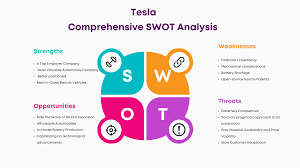
SWOT (Strengths, Weaknesses, Opportunities, Threats) analysis helps you analyze Tesla internally and externally in a structured way. Here’s what it looks like:
Innovative Technology: Tesla leads in EV innovation, autonomous driving, and battery tech.
Strong Brand Identity: Globally recognized and admired.
Supercharger Network: Gives Tesla vehicles long-distance travel reliability.
Vertical Integration: Tesla produces many of its own components in-house, reducing supplier dependence.
Production Delays: Tesla often overpromises on delivery dates.
Customer Service Gaps: Many global regions lack Tesla service centers.
High Vehicle Prices: Reduces affordability in emerging markets.
Overreliance on CEO Elon Musk’s Image: Public controversies may affect stock and brand.
Expansion in Asia and Africa: Tesla can tap into the growing demand for sustainable transport.
Affordable EV Models: Introducing budget-friendly models could double market penetration.
Energy Products: Solar panels and storage batteries like Powerwall can drive new revenue.
AI & Self-Driving: Tesla can dominate autonomous mobility with continued R&D.
Aggressive Competition: Rivals like BYD, Nio, Lucid, and legacy automakers are catching up.
Raw Material Shortages: Lithium and chip shortages can slow production.
Policy Shifts: Changes in tax incentives and safety laws may affect operations.
Cybersecurity: Increased digitalization invites cyber risks.
Harvard professor Michael Porter created this model to analyze industry competitiveness. Here’s Tesla’s breakdown:
High cost of entry and technology acts as a barrier.
However, new players backed by governments and VCs (e.g., Rivian) pose a threat.
Tesla depends on specific suppliers for batteries and chips.
Shortage of rare minerals increases their power.
Buyers now have options beyond Tesla.
Tesla’s unique tech and design keep buyer power in check.
Public transport, hybrid vehicles, and even hydrogen fuel alternatives are viable substitutes.
Tesla must differentiate through brand and performance.
EV market is now a battlefield.
Companies like Ford, BYD, Toyota, and Mercedes aggressively compete with Tesla.

After the SWOT and Five Forces analysis, here are strategies Tesla can implement:
Affordable EV Models – Launch compact cars under $25,000 for developing markets.
Build Factories in Asia and Africa – Reduce costs and access emerging markets.
Strengthen Service Networks – Expand after-sales service centers in underserved regions.
Collaborate with Governments – Joint green projects and incentives.
Battery Recycling Innovation – Close the loop on battery life to ensure sustainability.
Autonomous Ride-Sharing Services – Monetize Tesla’s Full Self Driving (FSD) with robotaxis.
This strategic analysis helps students:
Apply theory to real-world business models.
Learn competitive positioning using top frameworks.
Understand global market dynamics.
Develop strategic thinking.
If you’re studying Business Strategy, Marketing, or Entrepreneurship, this is an ideal case study.
✅ Pro Tip: Include actual company data from Tesla’s official investor page and recent market trends. You can also cite from financial sources like Yahoo Finance and government EV policy websites to add credibility to your paper.

What is Tesla’s biggest strength?
Innovation and branding in the EV sector.
Which model works best for evaluating Tesla’s market position?
SWOT and Porter’s Five Forces combined.
Is Tesla’s competitive position strong?
Yes, but it faces increasing threats.
How can I structure my assignment?
Introduction → SWOT → Five Forces → Strategies → Conclusion.
How do I humanize my writing?
Use a natural, student-friendly tone and relatable examples.
Can I use images?
Yes, include Tesla model images with relevant alt text.
What citation style should I use?
APA is most common, unless your school prefers MLA/Chicago.
How many words should my assignment be?
Aim for 1,300–1,600 words for depth.
Is Elon Musk relevant to Tesla’s strategy?
Absolutely, but be objective in your analysis.
Should I mention Tesla competitors?
Yes—BYD, Lucid, Toyota, and legacy automakers.
What are strategic initiatives?
Actions Tesla should take to grow or defend its position.
Can I include charts?
Yes—charts on market share, production, etc., can boost marks.
How to improve my grade on this paper?
Apply theory accurately and cite real-world data.
Are there free plagiarism checkers?
Yes—use Grammarly, Quillbot, or PaperRater.
What if I don’t understand SWOT?
Visit Study Creek’s SWOT Tutorial
Do I need a conclusion?
Always summarize key findings and suggest strategic directions.
How can I avoid AI detection?
Humanize content, vary sentence structures, and use real citations.
Is Tesla a monopoly?
No, but it’s a leader in a competitive market.
How do I use Porter’s model in assignments?
Break it into 5 sections and relate each to Tesla.
Where can I get help writing?
Try Dissertation Hive’s assignment services
What is Tesla’s biggest weakness?
Inconsistent customer service globally.
How do I cite Tesla’s website?
Format like: Tesla Inc. (2025). Retrieved from https://www.tesla.com
Can I include future forecasts?
Yes—just ensure your sources are credible.
Do lecturers prefer real company examples?
Yes, especially in strategy and marketing units.

Evaluating Tesla’s competitive position is not just an academic exercise—it’s an insightful way to understand how modern businesses compete in fast-paced, high-tech global markets. Students who master this analysis build critical thinking and business intelligence that employers value.
STUDENT DETAILS (Fill in before submitting)
| Full Name | ________________________________ |
|---|---|
| Admission Number | ________________________________ |
| Lecturer’s Name | ________________________________ |
| Course / Unit Title | ________________________________ |
| Date of Submission | ________________________________ |
| Assignment Title | Using Porter’s Five Forces and SWOT Analysis to Evaluate Tesla’s Competitive Position and Recommend Strategic Initiatives |
Using Porter’s Five Forces and SWOT analysis, evaluate Tesla’s competitive position and propose strategic initiatives to strengthen its global market presence.
Tesla Inc., founded in 2003 by engineers Martin Eberhard and Marc Tarpenning and later joined by Elon Musk, is a globally recognized leader in the electric vehicle (EV) industry. With a mission to accelerate the world’s transition to sustainable energy, Tesla has disrupted traditional automotive markets through innovation, sustainability, and technological advancements. However, its competitive position continues to be challenged by new entrants, global market dynamics, regulatory shifts, and supply chain uncertainties.
To evaluate Tesla’s position and propose strategies for market dominance, this paper applies Porter’s Five Forces and a SWOT Analysis framework.
Porter’s Five Forces framework is a powerful tool for analyzing Tesla’s industry structure and competitive dynamics.
Barriers to entry in the automotive industry are high due to massive capital requirements, stringent regulations, and the need for advanced technology and skilled labor.
However, growing demand for EVs has attracted new startups like Rivian, Lucid Motors, and traditional automakers like Ford and Volkswagen transitioning into EVs.
Tesla’s brand loyalty, Supercharger network, and technological edge provide a defensive moat, but government EV subsidies can help new entrants.
Tesla relies on suppliers for batteries, lithium, semiconductors, and other key components.
The limited availability of battery-grade lithium and dependence on Panasonic and CATL give suppliers considerable power.
Tesla has responded by integrating backward (e.g., building its own Gigafactories and mining initiatives), which reduces supplier leverage.
Consumers now have more options for EVs, and Tesla’s premium pricing may push price-sensitive buyers to competitors.
Tesla enjoys a strong brand image and cult following, which reduces buyer power to some extent.
However, lack of customization options and service center availability could increase buyer dissatisfaction.
Traditional internal combustion engine vehicles still dominate many global markets, especially in developing nations.
Public transport, ride-sharing platforms (Uber, Lyft), and even bicycles are viable substitutes.
The threat is also rising from alternative green technologies, like hydrogen-powered vehicles.
Tesla faces stiff competition from both legacy automakers (BMW, Toyota, Mercedes, Ford) and EV specialists (BYD, Nio, XPeng).
Price wars, rapid technological advancements, and global capacity expansion have increased the intensity of rivalry.
Tesla maintains competitive advantage via software (Autopilot), vertical integration, and AI innovation.
A SWOT analysis identifies internal strengths and weaknesses, and external opportunities and threats to better inform Tesla’s strategic direction.
Brand Reputation: Tesla is synonymous with electric innovation and sustainability.
First Mover Advantage: Pioneer in EV mass production and energy solutions.
Technology Leadership: AI-based Autopilot, over-the-air software updates, and battery innovation.
Vertical Integration: Control over manufacturing, distribution, and software development.
Supercharger Network: Exclusive global fast-charging infrastructure.
Production Delays: Tesla has struggled with meeting timelines and delivery deadlines.
High Operating Costs: Manufacturing and R&D expenses are substantial.
Limited Model Range: Compared to traditional automakers.
Service Limitations: Sparse repair and maintenance networks in many regions.
Public Relations: CEO behavior and social media controversies sometimes hurt the brand.
Global EV Growth: Increasing government incentives for clean energy vehicles.
Emerging Markets: India, Southeast Asia, and Africa offer untapped growth.
Energy Division Expansion: Solar roofs, energy storage systems (Powerwall).
Autonomous Driving: Tesla can dominate this space if regulation and safety standards are met.
Fleet and Commercial Vehicles: Expansion into semi-trucks and robotaxis.
Intensifying Competition: Both traditional and EV-centric companies increasing R&D.
Supply Chain Disruptions: Lithium shortages, chip supply constraints.
Regulatory Hurdles: Changing emission and safety standards, tariffs.
Economic Downturns: High prices of Tesla models make them luxury goods vulnerable to recessions.
Cybersecurity Risks: Being tech-heavy, Tesla faces hacking and data theft concerns.
Based on the above analyses, the following strategic initiatives are recommended for Tesla:
Build Gigafactories in India, Brazil, and Eastern Europe to reduce delivery times, lower tariffs, and access local markets.
Local sourcing can reduce costs and political resistance.
Develop more affordable EV models to compete with budget offerings from BYD and Hyundai.
Release models tailored to local needs (e.g., compact cars for congested cities).
Invest in global service center infrastructure and partner with certified third-party mechanics.
Launch an AI-powered mobile app for predictive maintenance and customer support.
Continue investing in solid-state battery R&D to stay ahead of rivals.
Expand battery recycling programs to reduce raw material dependence.
Open Supercharger networks to other EV brands for revenue and goodwill.
Partner with governments and private players to co-develop smart charging grids.
Prioritize regulatory approvals in key countries for Full Self Driving (FSD).
Form partnerships or acquire AI firms to accelerate development.
Establish a professional communications team separate from the CEO’s Twitter/X activity.
Focus on corporate social responsibility (CSR) and climate impact reporting.
Tesla is an innovation-driven company with a strong competitive advantage in the EV industry. However, it faces challenges from evolving competition, supply chain risks, and customer service limitations. Through Porter’s Five Forces and SWOT analysis, it is evident that Tesla must adopt aggressive global strategies, diversify offerings, strengthen infrastructure, and improve market responsiveness to maintain and grow its leadership position in a rapidly changing global environment.
( Below is APA-style sample)
Porter, M. E. (2008). The Five Competitive Forces That Shape Strategy. Harvard Business Review.
Tesla Inc. (2023). Annual Impact Report. Retrieved from https://www.tesla.com
Forbes (2024). Tesla vs. EV Competition: A Global Market Race. Retrieved from https://www.forbes.com
CNBC. (2024). Battery Shortages and EV Manufacturing Challenges. Retrieved from https://www.cnbc.com
Delivering a high-quality product at a reasonable price is not enough anymore.
That’s why we have developed 5 beneficial guarantees that will make your experience with our service enjoyable, easy, and safe.
You have to be 100% sure of the quality of your product to give a money-back guarantee. This describes us perfectly. Make sure that this guarantee is totally transparent.
Read moreEach paper is composed from scratch, according to your instructions. It is then checked by our plagiarism-detection software. There is no gap where plagiarism could squeeze in.
Read moreThanks to our free revisions, there is no way for you to be unsatisfied. We will work on your paper until you are completely happy with the result.
Read moreYour email is safe, as we store it according to international data protection rules. Your bank details are secure, as we use only reliable payment systems.
Read moreBy sending us your money, you buy the service we provide. Check out our terms and conditions if you prefer business talks to be laid out in official language.
Read more