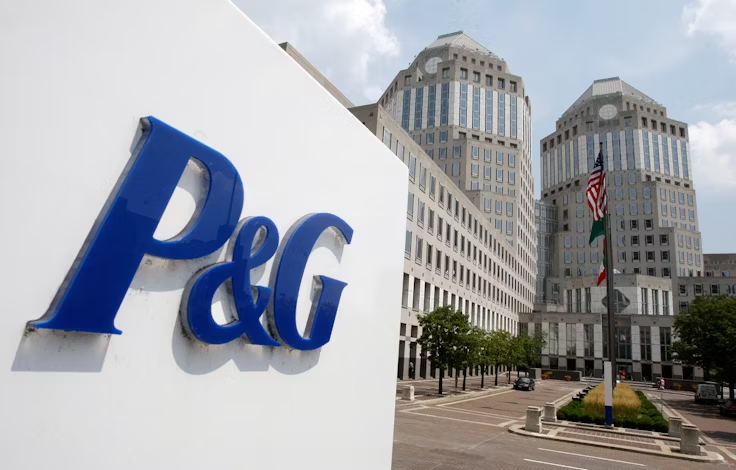
Procter & Gamble didn’t just build a business—they built a lifestyle. Founded in 1837, P&G has mastered the art of being everywhere in your home while remaining virtually invisible as a corporate entity. It’s like having a helpful roommate who stocks your entire house but never asks for credit. Genius? Absolutely. Slightly creepy? Also absolutely.
P&G has a brand portfolio that supplies American consumerism like a Greatest Hits collection:
Personal Care: Olay, Head & Shoulders, Pantene, Oral-B, Crest, Gillette, Old Spice Household: Tide, Downy, Cascade, Dawn, Febreze, Swiffer, Mr. Clean Health & Wellness: Vicks, Pepto-Bismol, Metamucil Baby Care: Pampers, Luvs
The strategy? Own every category where consumers make routine purchases. It is similar to Monopoly, except you are now trading in an item like toothpaste and laundry detergent.
Unilever joins brands such as Dove, Axe and Hellmanns into the fray. It’s P&G in fancy dresses, with multiple degrees and an art school who still sells soap.
J&J dominates baby care and healthcare products, competing directly with P&G’s Pampers and health portfolio. They are the ones, who make you feel guilty because of not using the so called gentle things and products.
Colgate specializes in oral care and personal hygiene by competing directly with Crest and Oral-B produced by P&G. It is a mouth war and both parties want to win it with all the whitening weapons.
Although Nestle is mainly focused on food, the company also competes in health and wellness segments, demonstrating that the company which can bring you chocolate, can also bring you vitamins.
P&G’s target market strategy is beautifully simple: target everyone who uses bathrooms, does laundry, or has hair. Their approach segments by life stage and need:
P&G pioneered the “slice of life” advertising approach, making mundane products feel essential to family happiness. Their Olympic “Thank You Mom” campaigns didn’t sell products—they sold feelings.
Continuous R&D keeps brands relevant. When everyone else was making soap, P&G invented Tide Pods. When competitors caught up, they invented Tide Pods that dissolve in cold water.
P&G has harnessed both e-commerce and social media and still had close links with traditional retailers. They are similar to your grandmother who knows how to use TikTok but still prefers to receive a phone call.
Contemporary consumers would like to see environmentally friendly products. The corporate responsibility of P&Gs sustainability goals, dubbed as, Ambition 2030, is not only necessary, but is brand protection.
P&G must strive to be real rather than anticipated, custom as opposed to market orientated, and sustainable instead of making quick money. In the future, both effective, and above all, authentic brands will have a future.
For marketing students analyzing this consumer goods titan, resources like StudyCreek provide comprehensive brand analysis frameworks. For deeper research support, DissertationHive offers specialized academic assistance.
The success of P&G is proof that good marketing sometimes is just being so intertwined with everyday life that people cannot live without you.
Sample Assignment:
Using segmentation strategies, what are the target market(s) for P&G? How does this relate to the company’s brand management strategies?
Who are the top three competitors of P&G, and what are their advantages/disadvantages with respect to their competitive product/service strategies?
P&G’s impressive portfolio includes some of the strongest brand names in the world. What are some of the challenges associated with being the market leader in so many different categories?
With social media becoming increasingly important and with fewer people watching traditional commercials on television, what does P&G need to do to maintain its strong brand images?
What risks will P&G face in the future?
Sample Answer:
Procter & Gamble: Segmentation, Competitors, and Brand Management in a Shifting Market
Name:
[Your Full Name]
Course:
[Course Title]
Instructor:
[Instructor’s Name]
Date:
[Month Day, Year]
Procter & Gamble (P&G) is a highly thriving consumer product corporation that has a wide range of products that includes health care, cleaning goods, hygiene products, as well as personals care. Combining a complex array of segmentation techniques, brand portfolio management, and tools of digital marketing, P&G can remain competitive and retain its global leadership. This essay will speculate on P&G segmentation, key competitors, brand leadership issues, changing media plans, and the risks to the organization in the future to ensure the ability to compete in the long run in the highly dynamic global market.
Demographic, geographic, psychographic and behavioral types of segmentation are used to define P&G target markets. Demographically, the company cuts across a wide income bracket considering that it deals with high-end and low product lines- in this case they have Pantene which targets up market and then the Head & Shoulders which targets mass markets. The psychographic segmentation is important since much of the P&G marketing is based on lifestyle and emotional attachment, including the Always campaign, Like a Girl, which gave girls power to say it like a girl (P&G, 2020). P&G customizes its products offerings through usage frequency and brand loyalty approach-Using Apps, high frequency buyers of Tide could receive loyalty-based offers or coupons.
This segmentation directly contributes to the brand management essence of P&G whose approach is based on a House of Brands approach. Individual brands have the freedom to market themselves individually without confusing consumers. This approach also simplifies the innovation and repositioning of separate brands based on market trends that do not interfere with the corporate image as a whole (Kotler & Keller, 2016).
P&G’s top three competitors include Unilever, Johnson & Johnson, and Colgate-Palmolive.
Unilever also boasts an equally huge product portfolio and is a significant competitor in household cleaning and personal care. Its strength is its powerful worldwide presence and assertive sustainability packaging (e.g. Dove Real Beauty campaign). Its demerit however is the lack of coherence in its performance regionally and the complicatedness in its brand integration as a result of recent acquisitions.
Johnson & Johnson (J&J) has become proficient in the healthcare and pharmaceutical sectors, which provides it with a competitiveness advantage concerning health conscious and baby care consumers (e.g. Aveeno, Neutrogena). Its weakness however is that it lacks the levels of diversification in non-health consumer products as P&G.
Colgate-Palmolive is a powerhouse in the oral care industry, especially thanks to its iconic Colgate brand. The company benefits from a loyal customer base and a strong foothold in global markets, particularly in emerging economies. However, it does have a drawback: its product lineup is not as extensive as P&G’s diverse offerings.
P&G faces pressure from each competitor to keep pushing the envelope in terms of innovation, pricing, and targeted marketing strategies.
Being a top player in multiple categories offers significant advantages, but it also comes with its own set of challenges. For example, P&G has to deal with brand cannibalization among its overlapping product lines. Tide, Gain, and Ariel all target similar markets, so it’s vital to keep them distinct. Moreover, market leadership often leads to heightened regulatory scrutiny and public criticism, especially regarding sustainability and supply chain ethics. Lastly, with such a wide range of brands, ensuring consistent quality, maintaining brand equity, and fostering innovation across the entire portfolio can be quite complex and costly (McKinsey & Company, 2021).
P&G has to stay quick on its feet, no matter how big it gets. Smaller, niche brands often have the upper hand over large corporations when it comes to jumping on trends—especially in sectors like organic products and eco-friendly packaging.
With traditional TV commercials losing their punch, P&G has turned its attention to digital and social media. The company is now heavily investing in influencer collaborations, interactive content, and direct-to-consumer engagement online. Campaigns like “The Look” and “Thank You, Mom” have taken off, garnering praise for their emotional depth on platforms like YouTube, Instagram, and TikTok (Forbes, 2022).
To maintain its strong brand images, P&G should:
broaden influencer partnerships by teaming up with micro-creators who genuinely resonate with specific niche audiences.
tap into user-generated content (UGC) to foster a sense of community around brands that people trust.
harness the power of data analytics to customize your marketing messages and offers in real time.
create direct-to-consumer channels to gather first-party data and boost customer lifetime value.
These initiatives will allow P&G to connect with digital-first consumers and solidify its brand identity in an increasingly decentralized media world.
Despite its strengths, P&G faces several key risks:
Shifting consumer preferences, particularly towards natural, organic, and cruelty-free products, could spell trouble for traditional brands if they don’t adapt swiftly.
Supply chain hiccups and rising inflation could drive up production costs and squeeze profit margins.
Data privacy laws can sometimes restrict how we target audiences, which might make personalized marketing less effective.
Competitive pressure from smaller, more agile direct-to-consumer (DTC) brands could start to eat into market share in particular niches.
To mitigate these risks, P&G should prioritize investing in a robust supply chain, fostering sustainable product innovation, and enhancing regulatory compliance systems. Being flexible, purpose-oriented, and digitally savvy will be key to achieving long-term success.
References
Forbes. (2022). How P&G Is Winning on TikTok and Beyond. https://www.forbes.com/sites/pg-social-media-success
Kotler, P., & Keller, K. L. (2016). Marketing Management (15th ed.). Pearson Education.
McKinsey & Company. (2021). What’s next for consumer goods brands post-COVID? https://www.mckinsey.com/industries/consumer-packaged-goods
P&G. (2020). Annual Report. https://www.pginvestor.com
Delivering a high-quality product at a reasonable price is not enough anymore.
That’s why we have developed 5 beneficial guarantees that will make your experience with our service enjoyable, easy, and safe.
You have to be 100% sure of the quality of your product to give a money-back guarantee. This describes us perfectly. Make sure that this guarantee is totally transparent.
Read moreEach paper is composed from scratch, according to your instructions. It is then checked by our plagiarism-detection software. There is no gap where plagiarism could squeeze in.
Read moreThanks to our free revisions, there is no way for you to be unsatisfied. We will work on your paper until you are completely happy with the result.
Read moreYour email is safe, as we store it according to international data protection rules. Your bank details are secure, as we use only reliable payment systems.
Read moreBy sending us your money, you buy the service we provide. Check out our terms and conditions if you prefer business talks to be laid out in official language.
Read more