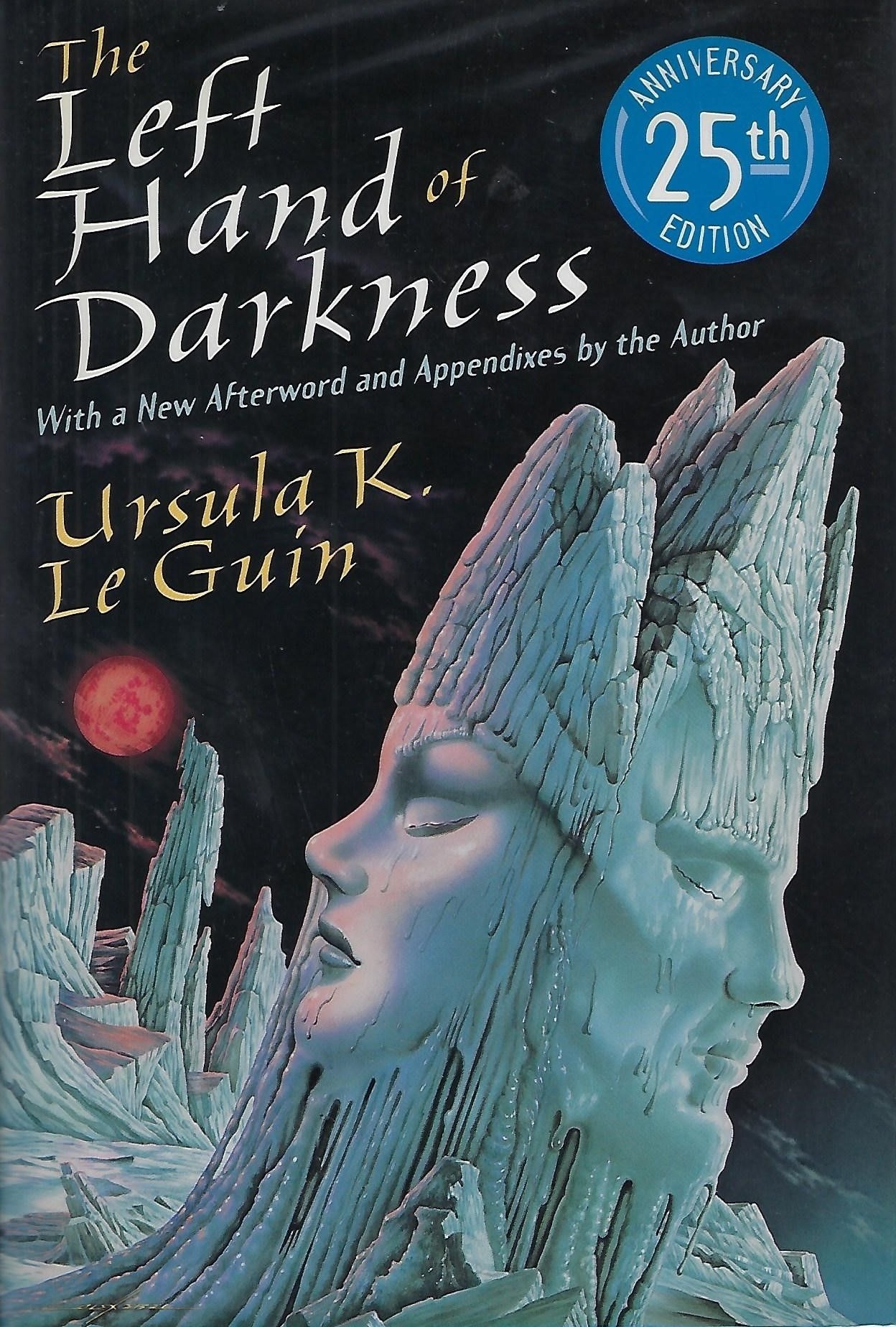
Ever thought about what would happen, were someone to take the notion of gender, blend it with political intrigue and serve on one of the frozen worlds of Gethen? Then Ursula K. Le Guin has just the book to satisfy your curiosity: The Left Hand of Darkness. This 1969 novel is not merely obtuse, it seizes the reader by the suppositions and gives him a gut-wrenching intellectual obstacle race, which quantum physics seems like a child’s book. It’s science fiction that doubles as social commentary, wrapped in a story that’s colder than your professor’s office hours.
The greatest poke in the eye of Le Guin is the development of the Gethenians- they are ambisexuals- they require each other to reach a state of kemmer (sexual readiness) and at random times become male or female. This is not only an imaginative world-building but a literary thought experiment in which the reader is compelled to deal with the fact of how gender permeates all facets of human society so profoundly. Seeing protagonist Genly Ai move around this world is akin to trying to explain color to someone who has never seen more than gray scale.
The genius of this style is revealed later when you understand that by making gender no longer a given Le Guin points out how fake a lot of our societal practices really can be. The Gethenians don’t have war in the traditional sense—coincidence? Le Guin suggests not. Without permanent gender roles, their society developed different power structures, different concepts of strength, and different approaches to conflict resolution.
Genly Ai serves as both protagonist and reader surrogate, struggling to understand a world where his basic assumptions about human nature don’t apply. The way in which he ultimately comes to acceptance reflects the same way that the reader struggles to accept what Le Guin is saying. He is more or less an anthropologist who is studying a culture that questions everything he believed that he knew about humanity, yet he is studied by the culture at the same time.
The emotional centre of the novel is his relationship with Estraven, the Gethenian politician who guides him and who becomes his companion. Their friendship grows in spite of–or maybe because of– the basic differences in the way they live in identity and relationships.
Against the backdrop of a political strained relationship between Karhide and Orgoreyn, the novel takes place in an alien setting in order to illicit very human themes of nationalism, loyalty, and political manipulation. The physical excursion across the ice is used as a character transformation incubator and philosophical awakening and the frozen planet is used as a logical metaphor to the emotional and political coldness that dominates both societies.
For literature students exploring gender theory, science fiction as social commentary, or speculative fiction’s role in challenging societal norms, “The Left Hand of Darkness” offers rich analytical opportunities. Whether you’re developing arguments for StudyCreek or conducting comprehensive research with DissertationHive, this novel demonstrates how authors can use fantastical elements to illuminate very real social issues.
Resources like StudyCorgi, EssayPro, EssayShark, and Edusson provide valuable support for students exploring feminist science fiction and genre theory.
The Left Hand of Darkness by Le Guin demonstrates that great science fiction never merely fantasizes alien worlds but makes you look at your own world in a new way and challenge the tacit assumptions that you never even realized you were making.
Read The Left Hand of Darkness including Le Guin’s Introduction & Answer both of the questions below using only the book as your referenced.
Identify and classify the major conflicts of the plot, identify the climax, and demonstrate which of the conflicts are resolved in it (this task will require bringing the plot threads together and paying especial attention to the Conditions of Victory). Identify this also—->>>>>Conflict (Man vs. Man, Man vs. Nature, Man vs. Himself; also who wins and how), Characterization as it reflects the conflict (Protagonist and Antagonist), Settings (where and when the fights take place), Point of View (Is the narrator a party to the conflict?), and Theme (What’s the fight all about?
300 Words
Evaluate the need for Chapter 7 in the novel. Identify its relationships to and effect upon the elements. 200 Words
Student Name
Instructor Name
Course Title
Date
Institution
The Left Hand of Darkness by Ursula K. Le Guin contains overlaid layers of conflicts that cut across political, personal, and existential struggles. The key conflicts are Man vs. Man, the strained relations between Genly Ai and Estravan and King Argaven; Man vs. Nature, the dangerous situation on the ice between Ai and Estravan; Man vs. Himself, the struggle with the inside biases of Ai against Gethenians. Ai completely embraces Estravan as an equal and a friend during the central climax of their evasion by the Gobrin Glacier (Le Guin 233). This moment resolves the internal and interpersonal conflicts—Ai overcomes his bias, and mutual trust is finally established. Nevertheless, the wider political war between Karhide and Orgoreyn is not quite over.
The main hero, Genly Ai, and the first antagonists like Estravan and King Argaven are reversible according to the plot. Estravan moves to the role of the perceived enemy to ally, opening the theme of the duality in Le Guin and idea of fluidity of identity. Characterization adds more depth to this conflict: Ai coming to understand the androgynous nature of the Gethen society is a shift in him that turns him into an insider rather than an outsider.
The setting—ranging from the political courts of Erhenrang and Mishnory to the harsh Gobrin Glacier—mirrors the conflicts. The glacier in particular makes the conflict Man vs. Nature hotter than ever, and forces Ai and Estravan to become dependent on each other. A first-person perspective alternates between Ai and Estravan, which makes a narrator an active participant and provides a reader with direct access to internal and external conflicts.
The overall theme is the conflict of fear and trust, alienation and understanding. The fight in the narrative has at its ultimate climax transcending difference, which is a political, social and personal struggle that assumes climax in reciprocity through respect and sacrifice.
Chapter 7, “The Question of Sex”, is critical to the comprehension of The Left Hand of Darkness. The chapter is a mythic and anthropological commentary on Gethenian sexuality, unlike the other chapters whose theme is primarily narrative-generated. It adds background to its genderlessness and allows readers to understand why Ai fails to overcome cultural prejudices (Le Guin 92). The chapter is a thematic keystone, and Le Guin focuses on gender duality, misconception, and identity.
When it comes to characterization, Chapter 7 also works well to reinforce it, by forcing the reader to question their assumptions, as Ai does. It supports conflicts in the novel especially Man vs. Himself by explaining how discrimination is based on cultural ignorance. The lack of the chapter would be incomplete to the reader in terms of the comprehension of the Gethenian society, and consequently, the change of character that is observed in Ai. It is vital that it enhances the world-building and the thematic depth simultaneously, which is why it is such a crucial element of the novel in terms of structure and message.
Le Guin, Ursula K. The Left Hand of Darkness. Ace Books, 1969.
Delivering a high-quality product at a reasonable price is not enough anymore.
That’s why we have developed 5 beneficial guarantees that will make your experience with our service enjoyable, easy, and safe.
You have to be 100% sure of the quality of your product to give a money-back guarantee. This describes us perfectly. Make sure that this guarantee is totally transparent.
Read moreEach paper is composed from scratch, according to your instructions. It is then checked by our plagiarism-detection software. There is no gap where plagiarism could squeeze in.
Read moreThanks to our free revisions, there is no way for you to be unsatisfied. We will work on your paper until you are completely happy with the result.
Read moreYour email is safe, as we store it according to international data protection rules. Your bank details are secure, as we use only reliable payment systems.
Read moreBy sending us your money, you buy the service we provide. Check out our terms and conditions if you prefer business talks to be laid out in official language.
Read more