
Welcome, future marketing gurus! You’ve found the Customer Relationship Management world, and you’re here because you’re either truly interested in the art of courtship of customers using digital means or panicked and baffled as to why companies are spending billions on software that in essence allows them to remember the birthdays of their customers. In any case, you’ve learned one of the most important (and profitable) skill sets in marketing.
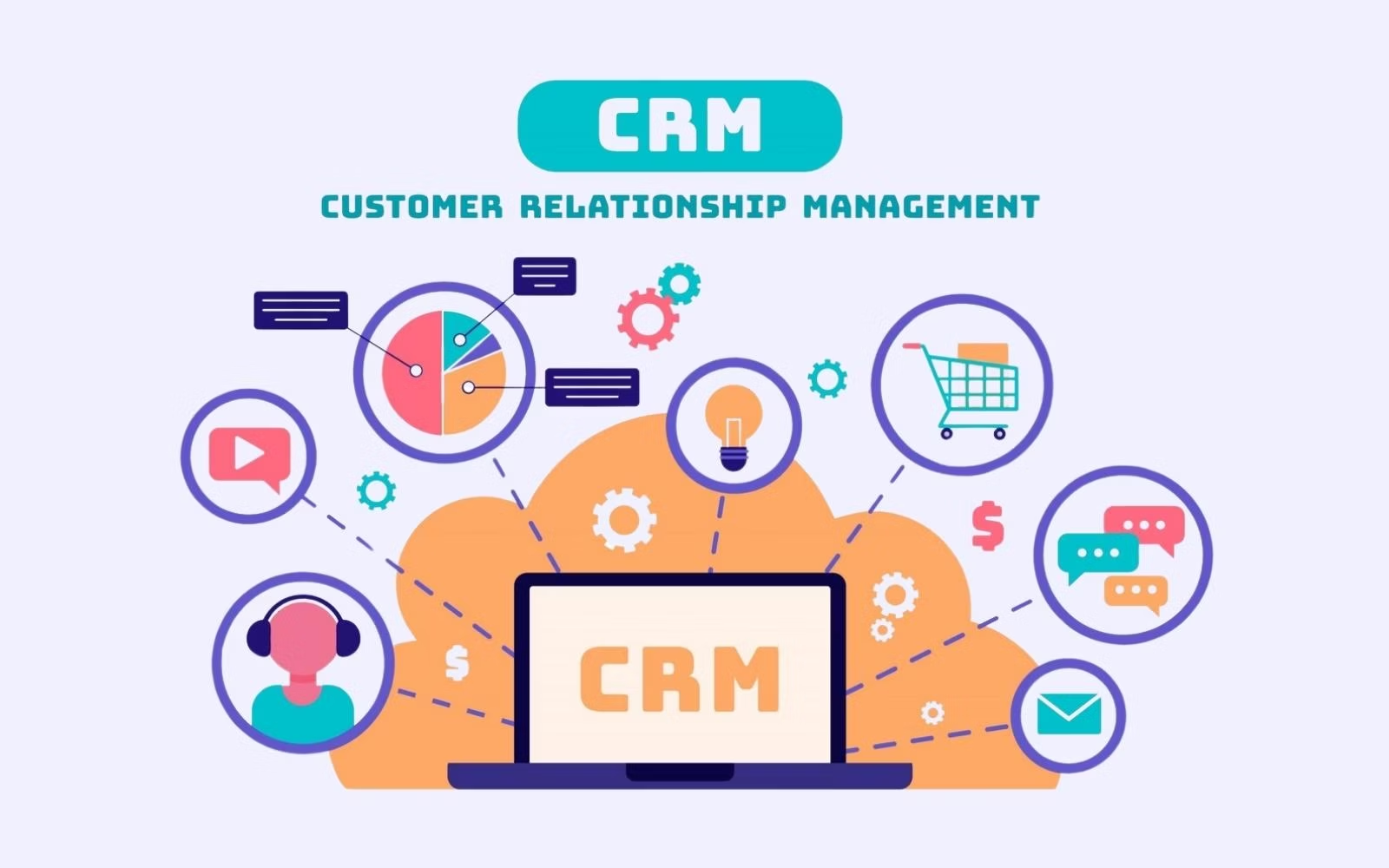
Customer Relationship Management is essentially the business version of being a great friend – only that your friends are thousands of customers and you’re not being reminded of their coffee preferences by means of natural interaction – you’re using vast databases and algorithms. It’s the strategic way of dealing with all contacts with current and potential customers to enhance relationships, customer retention and sales increase.
CRM can be considered the relationship counselor to the business in the end; it assists the business to navigate the sophisticated emotional frontier of customer demands, buying habits and loyalty trends.
Data-Driven Decision Making: CRM systems bring gut feelings to action. Rather than relying on her instincts as to what customers desire, you’ll be able to know when Sarah in the accounting department purchases her quarterly office supplies or why enterprise clients put their shopping carts down at 3 PM on Tuesdays.
Personalization at Scale: Consumers today demand that companies learn their names even when it comes to millions of consumers. CRM allows mass customization to the extent that every customer is treated like a favorite child of your company – a marketing miracle and Don Draper would weep with joy on seeing it.
Customer Lifetime Value Optimization: CRM helps identify which customers are worth pursuing long-term versus those who are essentially expensive one-night stands. It’s the difference between building sustainable revenue streams and constantly chasing new prospects like a caffeinated sales intern.
Lead Scoring and Nurturing: All prospects are not equal. CRM systems prioritize potential customers by score across engagement, demographics and behavioral information, enabling marketers to concentrate their efforts on the most lucrative potentials.
Segmentation and Targeting: Advanced CRM offers the ability to do highly detailed customer segmentation, not based solely on simple demographics but also in customer behavioral patterns, purchase history and predictive analytics.
Omnichannel Integration: Contemporary CRM systems have been able to integrate together customer engagements in the email, social media, telephone and face-to-face channels and create smooth communications that customers really love.
Firms such as Amazon, Netflix and Salesforce have established CRM empires. The recommendation engine used by Amazon, the personalization of the content offered by Netflix, and the CRM platform developed by Salesforce itself show how customer data can be turned into competitive benefits and billion-dollar valuations.
The biggest mistake? Using CRM as a tool to develop a relationship rather than as a glitzy contact database. Most firms allocate large sums of money in purchasing systems and yet they don’t develop the processes, training and changes in culture that would make CRM successful.
The study of CRM implementation and strategy needs the knowledge of both technical and strategic marketing concepts. Resources like StudyCreek offer comprehensive case study analysis, while DissertationHive provides in-depth research support for complex CRM projects.
It’s important to remember that CRM isn’t only a management of the customers, but also the development of the sustainable competitive advantages due to the excellence of relationship intelligence. Learn this and you’ll never have a problem justifying your worth during job interviews. So get out there and relationship-manage the way the future marketing executive you will be would do!
Sample Assignment:
How has customer relationship management (CRM) evolved or changed with the rise in the popularity of social media? Explain.
Sample Answer:
The Evolution of Customer Relationship Management in the Age of Social Media
Student’s Name
Course Title
Instructor’s Name
Date
Customer Relationship Management (CRM) has experienced major changes in the last twenty years, especially due to emergence of social media. Conventionally, CRM was perceived as database, software and structured procedures through which organizations had collected, analyzed and managed customer information. It was mainly aimed at enhancing affiliations, monitoring interactions and enhancing loyalty. The rise of social networks like Facebook, Twitter (X), Instagram and LinkedIn, however, has transformed CRM as a purely transactional, data-driven process into a highly interactive, real-time and community-driven process.
Among the most significant modifications, one should note the transformation in the relations of communication. Previously, the method and timing of communication between organization and customers were pretty much dominated by the organization as this was usually done through email campaign, newsletters or call centres. Through social media, customers are initiating conversations, leaving comments in the open and are demanding quick responses. This has compelled the CRM systems to incorporate social tools of listening so that the companies can monitor mentions of their brands, customer sentiment and to proactively interact. The communication has ceased to be a one way flow but a two way communication that demands that the brands become more responsive and open.
The second important evolution is the rise of the significance of personalization. Social media sites are able to generate enormous user data, such as preferences and browsing habits, demographics and social activities. CRM systems have changed to include more sophisticated analytic and artificial intelligence to customize marketing communications, product and customer experiences. Simply, a brand will now be able to know when a customer tweets that they need a new laptop and send them a personalized offer or customer service or send a personalized customer service message. This responsiveness creates greater loyalty and it shows that it is paying attention to the needs of the individual customers.
Moreover, CRM in the era of social media focuses on communing and brand promotion. Marketing is no longer limited to customers passively receiving the efforts of the marketing team; they have become an active participant in the brand perception. Business organizations are employing CRM systems that are combined with social media to create online community, reward loyal customers and convert satisfied clients into evangelists. Instagram or TikTok offer the customers the opportunity to become co-creators of the content, which enhances the level of trust and interaction.
Nonetheless, challenges come with this development. Along with social media is the threat of channel conflict and criticism by the public. Any negative remarks or bad customer services can easily spread like a virus and ruin the image of a brand. Consequently, real-time crisis management and reputation monitoring have to be part of CRM strategies. Also, the issue of data privacy has increased due to the rise in the use of social media and this has placed organizations at more transparent and ethical approach of their CRM strategies.
To sum up, the emergence of the social media has transformed CRM as an organized, database-based tool into the dynamic, interactive and customer-focused system. Organizations are now faced with the need to interact with customers in real time, personalize the experience, create communities and deal with reputational risk at a global scale. Best companies are those that do not consider CRM as a technology only but a relationship-building philosophy that constantly evolves to meet the changing digital environment.
Delivering a high-quality product at a reasonable price is not enough anymore.
That’s why we have developed 5 beneficial guarantees that will make your experience with our service enjoyable, easy, and safe.
You have to be 100% sure of the quality of your product to give a money-back guarantee. This describes us perfectly. Make sure that this guarantee is totally transparent.
Read moreEach paper is composed from scratch, according to your instructions. It is then checked by our plagiarism-detection software. There is no gap where plagiarism could squeeze in.
Read moreThanks to our free revisions, there is no way for you to be unsatisfied. We will work on your paper until you are completely happy with the result.
Read moreYour email is safe, as we store it according to international data protection rules. Your bank details are secure, as we use only reliable payment systems.
Read moreBy sending us your money, you buy the service we provide. Check out our terms and conditions if you prefer business talks to be laid out in official language.
Read more