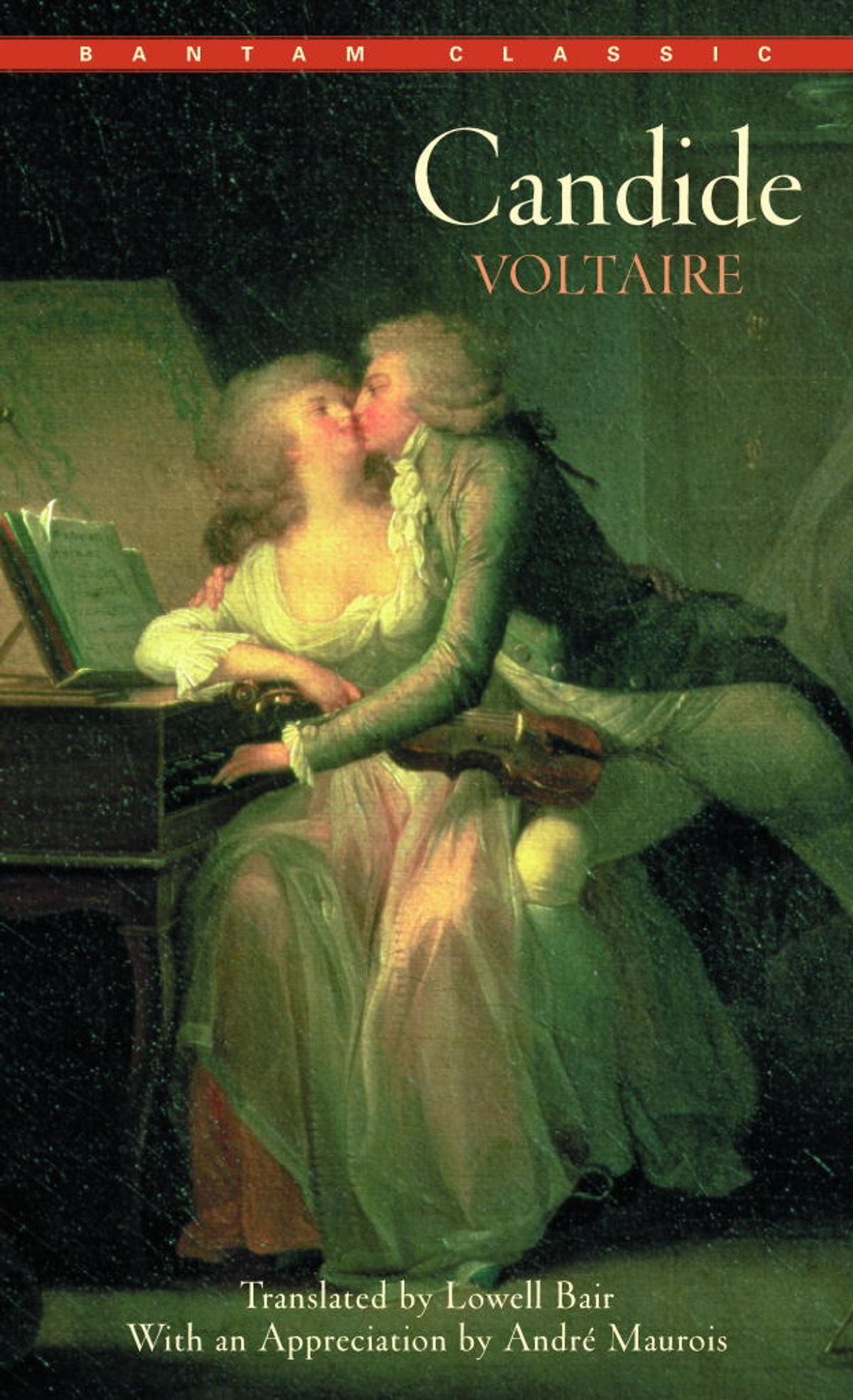
Greetings, literature students! Today, we’re diving into Candide, Voltaire’s brilliant satirical work from 1759 that really makes you think: “What happens when we take blind optimism and tear it apart over the course of 30 chapters?” If you’re looking for some guidance to help you navigate this philosophical wild ride, get ready—it’s going to be an absurdly educational experience!
Candide takes us on a wild ride with our unsuspecting hero as he faces a series of disasters that would make even Job raise an eyebrow and say, “Wow, that’s a bit much.” From earthquakes and wars to religious persecution, slavery, and torture, Voltaire really piles on the horrors for Candide. Meanwhile, his ever-optimistic mentor, Dr. Pangloss, keeps insisting that they’re living in “the best of all possible worlds.” In a nutshell, it’s a 200-page philosophical eye-roll aimed at Leibnizian optimism, all wrapped up in a quirky adventure.
Voltaire penned Candide as a sharp critique of Gottfried Wilhelm Leibniz’s idea that our world, crafted by a perfect God, must be flawless. Voltaire found this notion absurd—especially after witnessing the devastation of the 1755 Lisbon earthquake, which claimed thousands of lives. His response? Create a character who experiences every conceivable misfortune while parroting optimistic platitudes. It’s literary revenge served ice cold.
Pangloss as Walking Satire: Dr. Pangloss is optimism personified and catastrophically stubborn. Lost an eye and an ear to syphilis? “Everything is for the best!” Witnessing mass slaughter? “A necessary part of the best possible world!” He’s the person who’d call the Titanic sinking “a refreshing swim opportunity.”
If you’re a student working on analyses at StudyCreek or exploring topics at DissertationHive, check out these thesis-worthy themes:
Critique of Blind Optimism: Voltaire takes a sledgehammer to philosophical optimism, revealing just how absurd it is when faced with genuine suffering. As the horrors pile up, Pangloss’s reasoning starts to sound more and more ludicrous—a clever tactic to highlight how out of touch this philosophy is with the real world.
Religious Hypocrisy: Voltaire roasts religious institutions with gleeful abandon. The Grand Inquisitor keeps a mistress. A Franciscan steals jewels. A priest sells women into slavery. Subtle? No. Effective? Absolutely.
The Eldorado Episode: Candide stumbles upon a perfect society where gold holds no value and everyone lives in harmony. But, of course, he decides to leave in search of wealth elsewhere. This is Voltaire’s take on human nature—we often fail to appreciate paradise because we’re too busy chasing after shiny distractions.
“Cultivate Your Garden”: The famous line at the end isn’t really about gardening in the literal sense (though that’s nice too). It’s Voltaire’s way of saying: instead of getting lost in thoughts about cosmic perfection, we should concentrate on the practical, productive work that we can actually control. Revolutionary advice that remains relevant 265 years later.
Voltaire has a knack for deadpan humor, using understatement to shine a light on the absurdity of horrific events. His characters go through unimaginable experiences, yet they’re described with such casual simplicity that it creates a jarring contrast. This cognitive dissonance pushes readers to confront the shortcomings of the philosophy he critiques. It’s dark comedy meets Enlightenment philosophy meets travel narrative—basically the literary equivalent of a philosophical TED Talk gone delightfully wrong.
Candide is a shining example of Enlightenment satire, blending philosophical critique with a healthy dose of narrative irony. It’s short enough to wrap up before the deadline, yet rich enough to dive into some deep analysis. Voltaire shows us that you can be both intellectually sharp and downright funny—a valuable lesson to keep in mind when you’re tackling your own essays.
The takeaway? Question everything, reject blind faith in systems, and when philosophical theories fail spectacularly, tend your garden. Also, avoid tutors named Pangloss.
Now go forth and analyze. Your garden awaits cultivation.

[Name]
Instructor: [Instructor’s Name]
[Course]
[Date]
Title: Humor, Satire, and the Meaning of the Garden in Voltaire’s Candide**
Voltaire’s Candide is packed with humor – especially irony, exaggeration and absurdity – to poke fun at the social and philosophical optimism of the eighteenth century. By showcasing violent, tragic, or chaotic events through a comedic lens, Voltaire highlights the stark contradictions between lofty philosophical ideals and the messy reality of human existence. A prime example of this technique happens early in the novella when Candide is brutally “philosophically” beaten by the Bulgarians. Despite enduring near-death experiences and witnessing horrific violence, Candide clings to Pangloss’s optimistic mantra that “all is for the best in the best of all possible worlds.” The humor in this situation stems from the ridiculous clash between fear and his blissfully naive optimism. Candide’s unwavering faith becomes both laughable and unsettling.
In this scene, Candide finds himself on a battlefield strewn with the bodies of countless soldiers, referring to the carnage as “heroic butchery.” Voltaire’s writing is laced with a kind of exaggerated politeness that stands in stark contrast to the horrific reality unfolding before him. This clever use of humor serves two purposes: it pokes fun at the philosophical optimism of thinkers like Leibniz, while also shining a light on the hypocrisy of glorifying war. Rather than delivering a straightforward lecture, Voltaire invites his readers to laugh, prompting them to face the absurdity of viewing suffering as something necessary or even good. In this way, humor becomes a powerful tool—sharp, subtle, and capable of uncovering truths that more serious writing might dull or hide.
The final chapter of Candide takes a turn from humor to deep philosophical thought. The well-known phrase “Let us cultivate our garden” serves as both a literal and metaphorical idea. Literally, Candide and his friends work on a small piece of land to provide for themselves, turning away from the blind optimism that led them to so much suffering. The garden symbolizes practical effort, self-reliance, and a simple way of life. It signifies a retreat from the world’s chaos and a shift towards meaningful work.
The deeper meaning of the garden is truly significant. Throughout the novella, characters are on the hunt for wealth, fame, love, or even lofty philosophical ideas, but each of these quests ultimately leads to disappointment. By the end, Voltaire implies that true fulfillment doesn’t come from grand theories or worldly escapades, but rather from nurturing one’s inner self. The garden serves as a metaphor for personal accountability, moral growth, and intellectual humility. It’s a call to stay grounded in reality instead of getting lost in ideology.
The fates of each character at the end really back up this idea. Pangloss keeps spouting off his philosophical clichés, but nobody pays him any mind. Martin stays stuck in his pessimism, yet he still pitches in with the garden because having work gives his life meaning. Cunégonde may not be the beauty she once was, but she finds a sense of stability through her practical labor. The message is pretty clear: true happiness comes when people focus on what they can control—their work, their relationships, and their own moral integrity.
The figurative garden symbolizes a well-rounded life, one that thrives on hard work and a sense of humility. Voltaire encourages readers to reject abstract idealism in favor of thoughtful action. The humor that dominates the novella ultimately gives way to wisdom, reminding readers that cultivating one’s own “garden” is the surest path to meaning in an unpredictable world.
Delivering a high-quality product at a reasonable price is not enough anymore.
That’s why we have developed 5 beneficial guarantees that will make your experience with our service enjoyable, easy, and safe.
You have to be 100% sure of the quality of your product to give a money-back guarantee. This describes us perfectly. Make sure that this guarantee is totally transparent.
Read moreEach paper is composed from scratch, according to your instructions. It is then checked by our plagiarism-detection software. There is no gap where plagiarism could squeeze in.
Read moreThanks to our free revisions, there is no way for you to be unsatisfied. We will work on your paper until you are completely happy with the result.
Read moreYour email is safe, as we store it according to international data protection rules. Your bank details are secure, as we use only reliable payment systems.
Read moreBy sending us your money, you buy the service we provide. Check out our terms and conditions if you prefer business talks to be laid out in official language.
Read more