
Candidate assessment in today’s competitive employment landscape has become more urgent and strategic than ever before. To ensure fairness, consistency, and alignment with job requirements, organizations increasingly rely on structured evaluation methods. Two widely recognized systems for combining assessment scores are the multiple hurdles approach and the compensatory method. Each offers strategic benefits but also presents potential risks if misapplied. Therefore, it is essential that both students and practitioners of human resource management thoroughly understand how these methods operate. Whether explored in academic settings or applied in professional hiring processes, these candidate assessment techniques are critical for making informed, effective talent selection decisions.
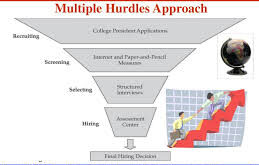
The multiple hurdles method involves a sequential elimination system, whereby the applicants should satisfy each phase to go to the next one. As an example, potential employees could initially go through a resume reading, then receive an aptitude test, then a face-to-face interview and in the end, have a background check. The outcome of a stage will result in disqualification of a candidate even though he or she may perform better in subsequent stages.
Elimination sequentially: those candidates who do not fulfill minimum requirements are discarded.
Job relevance: Every obstacle will be linked with an important job competency or competency requirement.
High selectivity: Suitable in high stakes where fitness will go to; i.e., law enforcement, aviation, or healthcare.
As much as this is an objective and risk-averse approach, it may be time-consuming and may end up dismissing otherwise-strong candidates who fail in one aspect.
On the contrary, the compensatory method combines all the scores (of assessment) into one composite score. A candidate who does not present a good score in one aspect can still be taken into consideration when he/she has one successfully. This approach is more loose and in many occasions when general possibility or general competence does matter more than personal proficiency.
Weighted scoring: The result of one assessment is used together with another assessment, and usually with different weights.
The compensatory approach can be more valuable to most modern organizations, particularly the ones concentrating on innovation and flexibility. It fits in dynamism that requires different skills and soft skills in the workplace. Nevertheless, it is better to apply the multiple hurdles model when the candidate selection needs strict and non-negotiable competencies.
Finally, it is up to you to decide based on your organizational needs, job requirements and strategic HR objectives. On academic or career sites, such as StudyCreek.com or DissertationHive.com, students and professionals may find detailed case studies, pieces of professional advice on HR practical work and techniques, which benefit any learning experience.
The methods are an effective method of candidate evaluation, though the choice has to be made carefully. Inconsistency between job requirements and the process of hiring employees may result in inappropriate decisions of hiring which is a waste of time and resources. By utilizing a validated evaluation system, you are bound to recruit not only the best candidate on the job, but the right candidate.
Get to know more about strategic HR information and recruitment case studies at StudyCreek and DissertationHive, learning and evolving are synonymous to expertise.
Below is a sample question:
There are two ways of combining candidates’ assessment scores so that they can be compared with one another. Discuss the multiple hurdles approach and the compensatory approach. Which approach to combining candidates’ assessment scores would you favor for choosing candidates? Why? Be certain to discuss key components used within each process.
Below is the answer to the sample question:
Title: A Comparative Analysis of the Multiple Hurdles and Compensatory Approaches in Candidate Assessment
Name: [Your Name]
Course: Human Resource Management
Instructor: [Instructor’s Name]
Date: [Insert Date]
Candidate assessment forms a crucial part of the human resource management strategic environment, which enables the organization to become successful in terms of the workforce. With great organizations being data-driven, the HR professionals now utilize systematic methods in calculating the evaluation of job candidates through the combination of the assessment scores.
Two well-established methods in this domain are the multiple hurdles approach and the compensatory approach. Each offers distinct strategies for managing candidate evaluation and selection, each with its strengths, limitations, and ideal contexts for use. This paper explores both approaches in depth, including their core components and practical applications. It concludes with a reasoned argument in favor of the compensatory approach, based on its alignment with modern, dynamic organizational needs.
Strengths:
Limitations:
The compensatory method adds the results of all assessments to come up with a composite score where good performance in an individual assessment is used to cancel out poor performance in another. This approach is more holistic in terms of an individual and their potential
May conceal fatal flaws unless scoring is set appropriately.
Increased possibility of subjective judgment without organization of processes.
Potential of under estimating desirable qualifications when the weighting is not well structured.
Although each of the two models has its evident benefits, the compensatory approach tends to be more consistent with the current requirements of organizations, especially in industries undergoing an increase in the value of adaptability, collaboration, and innovation.
Justification:
1.Fixed Position Flexibility: The current/contemporary positions require multi-degrees of talents thus can not be easily tested by a one-sided, elimination method. The compensatory model places a cover on the talent that could prove to be excellent in terms of their cognition ability on strategy or creativity despite not boasting of an exemplary technical ability.
2. Increased Inclusion and Variety: The current HR practices put focus on diversity, equity, and inclusion (DEI). The compensatory model helps to diminish the obstacle by underrepresented candidates as it acknowledges not only the skill brick but soft talents as well as growth.
3. The world of practice: In the real-life, not merely technical knowledge or test scores determine job performance. An employee who did not do so well in a preliminary test but is outstanding in inter-personal course or leadership abilities might end up being a more suitable cultural match and employee the task.
4. Organizational Agility: In many contexts, particularly volatile ones, such as in startups or healthcare innovation or creative industries, agility is always preferred over having the established technical expertise.
The compensatory model helps identify such adaptable talent.
Let’s consider a healthcare organization like Stevens District Hospital, undergoing digital transformation. A technical role may require knowledge in electronic health records (EHR) systems and patient communication. In the multiple hurdles approach, a candidate with weak technical test results but exceptional patient-centered communication may be eliminated.
Still, with the compensatory approach, their technical shortage might be compensated by excellence in soft skills, particularly, when training is possible.
The latter is indicative of the hiring in the real-world environment where training and development are included in the HR strategy, and the willingness to learn and develop can be appreciated more than the initial technical proficiency.
Human resource strategy revolves around its candidate assessment modes that should conform to the job requirements, as well as organizational targets. The multiple hurdles method provides stringent screening though it is strict thus potential talent may not be picked. Alternatively, the compensatory approach provides a more long-term, inclusive, and integrated process of the evaluation. The compensatory model works better in most contemporary workplaces that are aiming at enhancing agility, innovation, and diversity.
Learners, however, can continue learning information on such approaches and can be exposed to the real world of human resource challenges via such websites as StudyCreek.com and DissertationHive.com where they can find numerous sources of academic information, case studies, and even students which help them build their future career as human resource managers with the great impacts on the lives of people.
Delivering a high-quality product at a reasonable price is not enough anymore.
That’s why we have developed 5 beneficial guarantees that will make your experience with our service enjoyable, easy, and safe.
You have to be 100% sure of the quality of your product to give a money-back guarantee. This describes us perfectly. Make sure that this guarantee is totally transparent.
Read moreEach paper is composed from scratch, according to your instructions. It is then checked by our plagiarism-detection software. There is no gap where plagiarism could squeeze in.
Read moreThanks to our free revisions, there is no way for you to be unsatisfied. We will work on your paper until you are completely happy with the result.
Read moreYour email is safe, as we store it according to international data protection rules. Your bank details are secure, as we use only reliable payment systems.
Read moreBy sending us your money, you buy the service we provide. Check out our terms and conditions if you prefer business talks to be laid out in official language.
Read more