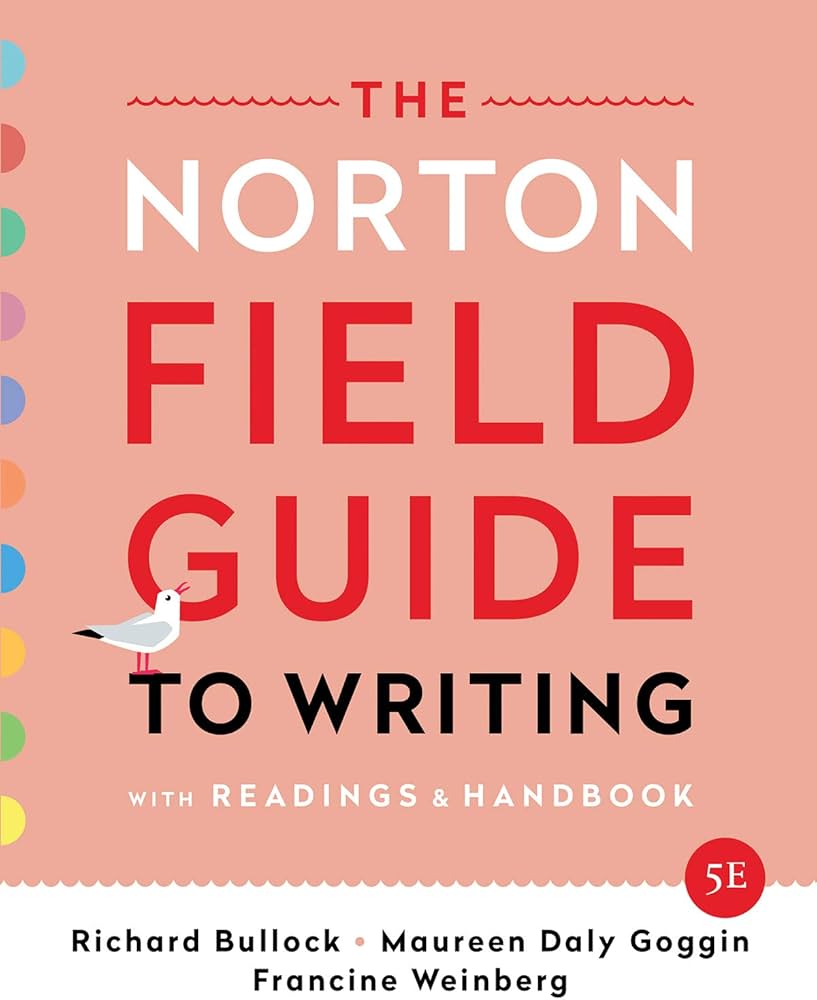
Dear literature students currently wrestling with The Norton Field Guide to Writing with Readings while questioning whether you need a PhD just to understand a writing textbook: welcome to the club of academically overwhelmed souls. If you’re staring at this 800-page tome wondering whether it’s a comprehensive writing guide or a doorstop disguised as educational material, you’ve encountered one of higher education’s most simultaneously helpful and intimidating resources.
The Norton Field Guide functions as the literary equivalent of that friend who always knows exactly what to say in every situation—except this friend weighs three pounds and costs more than your monthly coffee budget. This all-encompassing guide aims to tackle every possible writing hurdle, ranging from simple grammar rules to intricate rhetorical analysis. It’s such a detailed resource that you might even need a manual just to navigate it!
Structure and Organization: Thanks to its modular structure, the guide allows students to jump straight to the sections they need, sparing them from having to read the entire book—a considerate design that helps keep academic burnout at bay. Each section builds upon previous concepts while maintaining independence, creating a reference system that actually functions like a reference system rather than a linear narrative you’re doomed to read sequentially.
The guide’s rhetorical analysis sections provide frameworks that transform vague literary impressions into sophisticated academic arguments. Instead of writing “Shakespeare uses metaphors effectively,” students learn to analyze how specific rhetorical devices function within larger argumentative structures—the difference between amateur book reports and scholarly analysis.
Reading Strategies: The integrated readings demonstrate analytical principles in action, showing how professional writers employ techniques the guide explains theoretically. This approach prevents the common student experience of understanding concepts in isolation but struggling to apply them practically.
The guide’s genre-specific sections address the unique challenges of different academic writing forms. Whether students are putting together personal stories, argumentative essays, or research papers, they get solid strategies instead of the usual generic advice about “writing clearly.” This kind of guidance is genuinely helpful and goes beyond the obvious.
Research Integration: The research sections present organized approaches to evaluating sources, citing them properly, and building effective arguments. This way, you can avoid the academic tendency to just throw citations at a wall and see what sticks.
The guide’s literary analysis sections specifically address close reading techniques, textual evidence integration, and critical theory application—skills essential for literature coursework but often poorly explained in other contexts.
For additional analytical frameworks and writing strategy guides, StudyCreek offers comprehensive resources that complement The Norton Field Guide’s methodological approaches.
Feeling overwhelmed by The Norton Field Guide? If you need some specialized help with certain writing challenges, platforms like DissertationHive, StudyCorgi, EssayPro, EssayShark, and Edusson are here to help. They offer targeted support for enhancing your academic writing and literary analysis techniques.
The reason The Norton Field Guide is so successful is that it sees academic writing as a skill that can be learned, not just a talent that some people are born with. Its systematic method takes the mystery out of scholarly writing conventions, giving you the practical tools to refine your rough ideas into clear academic arguments.
Keep in mind that getting a grip on The Norton Field Guide isn’t merely about memorizing all its sections. It’s more about being able to tap into the right information when you need it. So, let’s quit procrastinating and start writing, using one of the most extensive resources available in academia!
Sample Assignment:
Read and discuss in The Norton Field Guide to Writing with Readings, 3rd ed Ch. 58, LAUREL THATCHER ULRICH, “Well-Behaved Women Seldom Make History, p. 656.” Read this essay to write the Reader Response plus Research papers. The Reader Response plus Research papers should be approximately 400-450 words long. For each entry, include the author’s name, the title of the work, and the date assigned for class. Also include full citation information for additional sources.
Use proper in-text citations. A thoughtful reflection on your reading of the piece—evidence that you have “engaged” the text. The avoidance of gratuitous plot summary or condensation. Research to support your reflection/argument. Each entry should be typewritten, double-spaced, and free from excessive mechanical and technical errors. Follow MLA 2009 guidelines regarding format. Do not skip lines between paragraphs.
Sample Answer:
[Name]
Professor [Name]
[Course Title]
[Date]
Reader Response to Laurel Thatcher Ulrich’s “Well-Behaved Women Seldom Make History”
In her essay “Well-Behaved Women Seldom Make History,” Laurel Thatcher Ulrich examines how women’s contributions are frequently overlooked or diminished in the historical narrative, particularly when they align with societal norms. This iconic phrase – often misinterpreted as a bold call for rebellion – was initially a nuanced observation about the lack of recognition for obedient women in history. What really caught my attention while reading Ulrich’s work was her insight into how the phrase evolved from academic discourse to a pop culture catchphrase. This shift reveals a deeper truth: for women to be remembered, they often need to break the mold instead of just fitting into it.
Ulrich’s essay prompts readers to rethink whose stories are celebrated and remembered. She critiques the traditional historical narratives that often focus on male achievements, highlighting the structural erasure of women who didn’t fit the “loud” or revolutionary archetype. This made me consider how history textbooks frequently emphasize figures like Rosa Parks or Joan of Arc – women who are remembered for disrupting the status quo. In contrast, many women who quietly maintained families, communities, and institutions are seldom acknowledged. Ulrich argues that both kinds of women – those who followed the rules and those who broke them – deserve a place in our historical narrative.
Supporting Ulrich’s argument, historian Judith M. Bennett emphasizes the importance of examining the daily lives of medieval women to understand their agency, even within patriarchal constraints. In her book History Matters: Patriarchy and the Challenge of Feminism, Bennett notes that “we ignore the power exercised by ordinary women at our peril” (Bennett 19). Similar to Ulrich, she argues that history needs to widen its perspective to include not only the well-known revolutionary figures but also the essential, often overlooked, contributions of women throughout time.
Moreover, Bell Hooks, a prominent feminist scholar, highlights how memory and visibility are inherently political concepts. In Feminism is for Everybody, Hooks writes, “the absence of adequate historical representation for women of all races reinforces existing hierarchies of power” (Hooks 33). This notion strikes a chord with Ulrich’s worry about who is remembered and who is overlooked. Ulrich’s push to acknowledge “well-behaved” women isn’t a dismissal of assertive feminism; it’s more of a call to adopt a broader, more inclusive understanding of women’s contributions to society.
In her thought-provoking essay, Ulrich prompts us to rethink the essence of making history. She urges both scholars and everyday readers to recognize the significance of defiance and hard work, along with protest and perseverance, in examining the historical impact of women’s lives.
Works Cited
Bennett, Judith M. History Matters: Patriarchy and the Challenge of Feminism. University of Pennsylvania Press, 2006.
hooks, bell. Feminism Is for Everybody: Passionate Politics. South End Press, 2000.
Ulrich, Laurel Thatcher. “Well-Behaved Women Seldom Make History.” The Norton Field Guide to Writing with Readings, 3rd ed., edited by Richard Bullock, Maureen Daly Goggin, and Francine Weinberg, W.W. Norton & Company, 2013, pp. 656–660.
Delivering a high-quality product at a reasonable price is not enough anymore.
That’s why we have developed 5 beneficial guarantees that will make your experience with our service enjoyable, easy, and safe.
You have to be 100% sure of the quality of your product to give a money-back guarantee. This describes us perfectly. Make sure that this guarantee is totally transparent.
Read moreEach paper is composed from scratch, according to your instructions. It is then checked by our plagiarism-detection software. There is no gap where plagiarism could squeeze in.
Read moreThanks to our free revisions, there is no way for you to be unsatisfied. We will work on your paper until you are completely happy with the result.
Read moreYour email is safe, as we store it according to international data protection rules. Your bank details are secure, as we use only reliable payment systems.
Read moreBy sending us your money, you buy the service we provide. Check out our terms and conditions if you prefer business talks to be laid out in official language.
Read more