Employee engagement is not a luxury but a requirement in the modern business world that is characterized by dynamics. Due to the growing global competition, technology, and diversity of the workforce, the capacity to engage employees has turned out to be a strategic concern as organizations seek to attain their goals and objectives. Employee engagement is a complex phenomenon that has to be understood by students who study business, human resource management (HRM), psychology, or organizational behavior.
If you need to write a dissertation or a coursework paper or just enrich your knowledge, this is a comprehensive Article that describes the dimensions, strategies, and implications of employee engagement. In case you need some scholarly assistance with developing a quality research on this subject matter, you can count on professional help at StudyCreek.com and DissertationHive.com.
Employee engagement describes how an employee feels towards his organization and its objectives. It is not a mere job satisfaction or happiness of the employees, it is more of how committed the employees feel to their work and how much they are eager to play their part in the success of the organization.
The Gallup organization defines employee engagement as the interest and dedication of the staff to the job and the working environment.
David MacLeod and Nita Clarke, the architects of the Engage for Success report in the UK, highlight the importance of engagement by saying that it is ìthe way we makes the conditions in which employees wish to bring more of their capacity and potential to work.
And to the students who are pursuing management or HRM as their subject, learning and having the touch of the concept of employee engagement will offer them a decent commencement in learning and knowing about the performance of a workforce, the efficacy of leadership and the kind of culture an organization has.
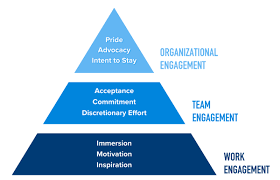
In a report released by Gallup it was stated that highly engaged teams are 21 percent more profitable and 17 percent more productive.
Employees would not want to leave easily when they feel being part of something and treasured. This reduces the cost of recruitment and training.
The involved employees are likely to introduce new ideas to the company, which would ensure the constant development and the competitive advantage.
The cheerful and inspired employees work happier, and it influences the experience and loyalty of the customers.
This participation by the employees will introduce the feeling of belonging, and it adds meaning, which will serve to support the feeling of organization commitment.
And as the students are writing their essays or dissertation about the human resource management, it will make their work more academic when they insert some real world statistics and case studies which can be found on the reliable sources such as SHRM or CIPD. DissertationHive.com provides dissertation writing services when you require some minor help with formatting of your arguments or data analysis.
Engagement is not a one-dimensional concept. Scholars and practitioners often explore several components:
The emotional attachment an employee feels toward their job role and company.
The degree to which employees are intellectually absorbed in their work.
The observable actions employees take—such as going the extra mile, showing initiative, or participating in team activities.
These dimensions provide a framework for academic analysis. Students researching engagement strategies may explore how each component contributes to overall job performance.
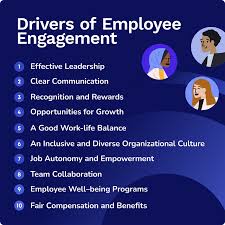
In management it is enough to understand what is it that is captivating. The common causes include:
The management must be open, inspiring. When leaders speak about vision and strategy a direction is created.
The morale booster is recognition. The recognition can be both of formal (bonuses, awards) and informal (praise, thank-you notes) nature.
Employees engaged in continuous learning are more invested. Opportunities for growth increase engagement.
Better well-being and less burnout are provided by flexible schedules and respect of personal time.
All these drivers could be examined individually or might be incorporated into a more significant HRM approach. The students seeking assistance with designing engagement surveys or qualitative interviews may refer to the experts at StudyCreek.com.
Measuring Employee Engagement
Common Tools and Methods:
Example Survey Question:
Both quantitative and qualitative data collection should be considered by the students who study the methodology of the research.
For professional guidance in structuring your engagement research project, DissertationHive.com offers expert consulting.
1. Kahn’s Engagement Theory
William Kahn (1990) put forward the idea that individuals bring themselves to bear physically, cognitively and emotionally to work when they feel psychologically meaningfulness, safety and availability.
2. The Job Demands-Resources (JD-R) Model
According to this model, engagement is described in the context of the equilibrium between job requirements and the resources that are available.
3. Maslow Hierarchy of Needs
This theoretical pillar can be used to describe motivation and engagement, ranging over the primitive needs to self-actualization.
4. Self-Determination Theory (SDT)
Autonomy, competence, and relatedness are highlighted as crucial to intrinsic motivation and engagement.
Each model presents an opportunity for in-depth academic analysis. Students can draw comparisons or test model applicability in different organizational contexts. If you require assistance conducting a literature review on these theories, StudyCreek.com can help.
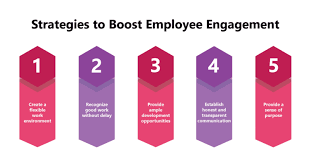
Uncle clarity is a disengage. The managers are also expected to come up with SMART (Specific, Measurable, Achievable, Relevant, Time-bound) goals.
2. Give Constant Feedback
Engaged employees crave constructive feedback. Performance appraisals should be regular and two-way.
3. Encourage Employee Voice
Platforms for employees to express ideas or concerns foster trust and innovation.
4. Invest in Training and Development
Training is not only a skill enhancer but also a motivator. For insights into learning and development strategies, students can check StudyCreek’s academic resources.
5. Create a Positive Work Environment
Physical space, social climate, and organizational values all contribute to engagement.
For HR students crafting engagement strategies as part of coursework or a capstone project, professional editing or writing support is available at DissertationHive.com.
brings numerous benefits, it also faces certain challenges:
In the remote and hybrid work modalities, it becomes more difficult to achieve team cohesion.
Compared to Baby Boomers, millennials and Gen Z have other expectations, which requires flexible engagement strategies.
When the demands are high and lack support, it reduces the level of engagement.
Disconnected leadership team, in most cases, makes the workforce disconnected as well.
Employee engagement is a global concern, with regional nuances:
United States: A strong culture of performance and innovation drives engagement strategies.
Africa and the Middle East: Cultural sensitivity and economic variability shape engagement models.
Students writing comparative essays or dissertations can explore how engagement varies across cultures and industries. For region-specific research help,
offers comprehensive academic assistance.
Google is known to have an innovation culture, and in order to foster it, the company emphasizes autonomy, growth, and inclusion.
The company also talks about the employees as partners, which implies the respect and the common objectives.
This analytic company offers its employees a good work environment which is one of the reasons that have led to the highest retention rates in the industry.
These case studies can be analyzed by students and used in order to learn best practices and implement them in a real-world setting. In case you require writing an attention-grabbing case study section in your dissertation, contact DissertationHive.com.
While often used interchangeably, the two differ:
Job Satisfaction is about how happy an employee is.
Employee Engagement is about how committed and motivated the employee is to achieve goals.
Engaged employees may not always be satisfied, and satisfied employees may not be engaged. This distinction is a rich area for academic exploration. If you’re tackling this topic in a research paper, use internal support from StudyCreek.com for academic proofreading and citation help.
1. Collaboration Tools
Communication and engagement are supported by such platforms as Slack, Microsoft Teams, and Zoom.
2. HR Analytics The inclusion of data to determine engagement and predict turnover is getting fairly common.
3. Gamification
elements of games at the workplace increase motivation and interest. Technology may be a facilitator, as well as, inhibitor of engagement.
For students writing about the digital workplace, exploring both perspectives can make for a robust argument. For professional editing of your research, visit DissertationHive.com.
Future Trends in Employee Engagement
Personalized Engagement: Tailoring engagement initiatives to individual preferences.
AI and Predictive Analytics: Using AI to assess engagement and recommend interventions.
Wellness-Centric Engagement: Focus on mental health and holistic employee well-being.
Sustainability and Purpose-Driven Work: The younger employees are more committed when working in accordance with the environmental and social principles.
Students planning ahead to work in HR, management or organizational consultancy ought to be aware of these trends. And to remain academically competitive, use the study materials at StudyCreek.com or order future-oriented thesis writing at DissertationHive.com.
The following are the typical questions UK, USA, Canada, and Australia students ask about the keyword employee engagement, in academic, research, and professional development situations. These questions mirror assignment prompts, dissertation titles, research themes and the actual HR interest in the world.
Focused on academic timelines, internship periods, and seasonal organizational trends.
Research Trends (May–August):
Final-year undergraduate dissertations (May submission).
Master’s thesis projects (June–August).
HR internship projects (summer employment).
Public sector organizational audits.
Common Topics:
Impact of employee engagement on service quality in NHS trusts.
Post-pandemic remote work and employee engagement in UK councils.
Engagement strategies in UK SMEs: A comparative sectoral study.
The influence of leadership style on employee engagement in public vs private sectors.
Role of HR analytics in tracking engagement trends in hybrid teams.
Students often work with data from companies like BT Group, Tesco, or the British Civil Service.
I will find DissertationHive.com very useful when analyzing the data set or writing the results.
Research Trends (May–August):
MBA summer research projects.
Psychology/Human Factors internships.
Capstone projects for organizational behavior courses.
SHRM-based academic case studies.
Common Topics:
Employee engagement in U.S. tech companies: Pre- and post-COVID comparison.
Engagement strategies for remote workers in Silicon Valley.
Gamification and employee engagement in startups.
How DEI initiatives improve engagement across multicultural teams.
Engagement and performance alignment in nonprofit organizations.
Topics often incorporate Gallup or SHRM data. For help linking theoretical frameworks like Maslow or Kahn with case studies, students frequently consult StudyCreek.com.
Research Trends (May-Aug.):
Reports and summer co-op placements.
HR diploma and Bachelor’s degree final projects.
Field studies within Canadian Crown Corporations.
Common Topics:
Employee engagement in bilingual (French-English) workplaces: Case of Montreal.
Engagement strategies in the Canadian public sector (e.g., Service Canada).
Mental health programs and their effect on engagement in healthcare settings.
Evaluating employee engagement among Gen Z in Canadian retail.
Leadership transparency and its influence on engagement in remote-first startups.
Students often combine qualitative and quantitative analysis using surveys and interviews. For survey design support or SPSS analysis, DissertationHive.com is a trusted academic partner.
Research Trends (May–August):
Trimester-based dissertation submissions.
Internship or practicum reports for HRM, Business, and Psychology students.
Organizational research projects in industries like mining, healthcare, and education.
Common Topics:
Employee engagement challenges in the Australian mining industry.
Flexible work and engagement in Australian universities post-COVID.
Evaluating Indigenous employee engagement practices.
Engagement initiatives in Australian SMEs: A study of startup culture.
Effects of burnout and stress on engagement in aged care workers.
Australian students often focus on real-world implications and use APA referencing heavily. For assistance aligning field research with academic expectations, StudyCreek.com provides comprehensive support.
How This Helps You
Students conducting these research projects often face challenges such as:
Framing research questions.
Finding up-to-date academic sources.
Conducting data collection ethically.
Analyzing employee survey results.
To overcome these, they rely on:
StudyCreek.com for academic resources, topic help, and essay assistance.
DissertationHive.com for dissertation writing, editing, and data analysis services.
Common Courses Featuring Research on Employee Engagement
1. Human Resource Management (HRM)
Research Topics: The role of incentives in increasing employee engagement; DEI and engagement.
Universities: Harvard, University of Michigan, Cornell (ILR), University of Florida.
2. Organizational Behavior
Research Topics: How leadership styles influence employee engagement in tech startups.
Universities: Stanford, Wharton (UPenn), NYU Stern, UCLA.
3. Business Administration (MBA)
Research Topics: Employee engagement strategies in multinational companies.
Universities: Harvard Business School, Kellogg (Northwestern), MIT Sloan.
4. Industrial/Organizational Psychology
Research Topics: Psychological safety and the effects of the same on employee engagement.
Universities: Michigan State, Hofstra University, Colorado State University.
5. Workplace Wellness Programs
Research Themes: Workplace involvement in healthcare and mental health programs.
Universities: Emory University, University of Arizona.
1. MSc Human Resource Management
Research Topics: Consequences of performance management systems- Employee engagement.
Universities: University of Manchester, University of Leeds, University of Strathclyde.
2. Organizational Psychology
Research Topics: Emotional intelligence and employee engagement.
Universities: University College London (UCL), University of Sussex.
3. MBA/Business & Management Studies
Research Topics: Strategic approaches to boost employee engagement in hybrid workplaces.
Universities: London Business School, Warwick, Cranefield University.
4. Employment Relations
Research Topics: Trade unions and employee engagement: Complement or conflict?
Universities: University of Oxford, LSE.
5. Leadership and Management
Research Topics: Transformational leadership as a tool for improving engagement.
Research Topics: How rewards and recognition programs foster engagement in SMEs.
Universities: University of British Columbia (UBC), University of Toronto, Queen’s University.
2. Organizational Studies & Human Capital
Research Topics: Employee engagement in multicultural teams.
Universities: Western University, York University.
3. MBA in Leadership
Research Topics: Engagement strategies during organizational change.
Universities: Rotman (UofT), Schulich (York), HEC Montreal.
4. Public Sector Management
Research Topics: Engagement and motivation in federal or provincial government agencies.
Universities: Carleton University, University of Ottawa.
5. Workplace Health Promotion
Research Topics: The relationship between wellness programs and engagement levels.
Universities: McMaster University, University of Alberta.
1. Bachelor/Master of Human Resource Management
Research Topics: The impact of flexible work policies on employee engagement.
Universities: University of Melbourne, Macquarie University, University of Sydney.
2. Master of Management / MBA
Research Topics: Employee engagement as a competitive advantage.
Universities: Monash Business School, UNSW Business School, Griffith University.
3. Psychology with Industrial Focus
Research Topics: Job satisfaction, burnout, and engagement in Australian mining workers.
Universities: University of Adelaide, ANU, University of Queensland.
4. Leadership & Organizational Development
Research Topics: Leading with empathy to enhance engagement.
Universities: University of Western Australia, Deakin University.
5. Workplace Relations / Industrial Relations
Research Topics: Engagement in unionized versus non-unionized environments.
Universities: RMIT University, Curtin University.
How This Connects to Your Websites
Students studying these courses often:
Search for dissertation help, case study analysis, and literature reviews.
Need academic support for qualitative/quantitative research.
Look for tailored academic writing, referencing (APA/Harvard), or SPSS analysis.
✅ StudyCreek.com helps with course-based assignments and study support.
✅ DissertationHive.com offers dissertation writing, editing, and data analysis tailored to these academic programs.

It affects the productivity, retention, customer satisfaction and innovation. This topic is a must-learn area to achieve an academic and career advantage, especially by students who aspire to be at the top in business, psychology, HR, or sociology.
So, you are writing an essay on employee engagement, or maybe you are carrying out a case study or even a complete dissertation on employee engagement, the proper guidance can save the day.
For expert academic support, visit:
StudyCreek.com – Your partner in study success.
DissertationHive.com – Custom dissertation solutions from top-tier experts.
References and Further Reading
Gallup. (2023). State of the Global Workplace. https://www.gallup.com
CIPD. (2024). Employee Engagement: Factsheets. https://www.cipd.co.uk
SHRM. (2024). How to Improve Employee Engagement. https://www.shrm.org
Engage for Success. (UK Government Initiative). https://engageforsuccess.org
Delivering a high-quality product at a reasonable price is not enough anymore.
That’s why we have developed 5 beneficial guarantees that will make your experience with our service enjoyable, easy, and safe.
You have to be 100% sure of the quality of your product to give a money-back guarantee. This describes us perfectly. Make sure that this guarantee is totally transparent.
Read moreEach paper is composed from scratch, according to your instructions. It is then checked by our plagiarism-detection software. There is no gap where plagiarism could squeeze in.
Read moreThanks to our free revisions, there is no way for you to be unsatisfied. We will work on your paper until you are completely happy with the result.
Read moreYour email is safe, as we store it according to international data protection rules. Your bank details are secure, as we use only reliable payment systems.
Read moreBy sending us your money, you buy the service we provide. Check out our terms and conditions if you prefer business talks to be laid out in official language.
Read more