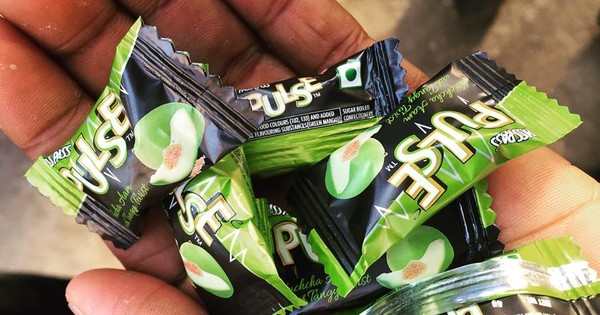
Imagine this: It’s 2015 and the market of India has found itself awash in a wave of sugary sweetness in the candy world. Children are gorging on the same old sugary bombs and parents have pretty much coded the candy section over to their children. Enter DS Group, a company that decided to throw a literal curveball—or should we say, a tangy masala bomb—into this predictable landscape.
Pulse was conceptualized sometime in 2013, and an internal team dedicated for product development worked for almost two years on it. The DS Group, founded in 1929 and already a powerhouse in spices and mouth fresheners, had an epiphany that would make marketing professors everywhere weep with pride. They realized that kachcha aam (raw mango) is a flavor that is consumed by people across India in some form or the other.
The stroke of brilliance? The candy is known for its special taste. It starts sweet, like raw mango, and then surprises you with a tangy masala center that would make your taste buds do a Bollywood dance number. This wasn’t just candy innovation; it was psychological warfare against boring confectionery.
Here’s where Pulse pulled off what marketing textbooks would call either genius or madness. Raw mangoes are relished by people of all age groups and geographies in India, so there was no particular target group singled out for Pulse. Instead of the traditional kids-only approach, they went full democratic—Anyone above 5 years of age was fair game.
Pulse buyers are primarily young Indian consumers who love trying exciting new products. The brand also attracts adult consumers who want a candy that satisfies more than just a sweet tooth. In marketing terms, they basically said, “Why limit ourselves to pocket money when we can tap into salary money too?”
In April 2015, the company decided to test market Pulse in just three northern states of Gujarat, Rajasthan and Delhi. This wasn’t about playing it safe—it was about being strategically smart. They understood that if you can win over the diverse palates of these three states, you’ve essentially conquered India’s taste map.
The results? Pulse Candy hit the market in 2015 and became a hit almost overnight. Within eight months, they achieved what most brands dream of in years—₹100 crore in sales. By 2024, Pulse candy recorded over INR 750 crore at consumer price in the FY 2024-25 translating into 750 crore Pulse candies being sold in one year making it India’s largest distributed hard boiled candy.
What makes Pulse a case study goldmine for marketing students? The numbers are not everything, it is the strategy. The brand identity has gone in as a fusion candy where the product possesses both sweet and tangy flavor, embracing youthful customers who aimed at experimental taste. They didn’t just create a product; they created an experience that “offered an unparalleled sensory experience to the consumer”.
For marketing students diving deep into case studies like Pulse Candy, having the right academic support is crucial. When you’re analyzing complex brand strategies or crafting your own marketing plans, platforms like StudyCreek offer comprehensive research assistance. For dissertation-level analysis, Dissertation Hive provides specialized support for in-depth academic projects.
Need additional academic resources? Consider StudyCorgi for sample papers, EssayPro for professional writing assistance, EssayShark for expert guidance, or Edusson for comprehensive academic support.
The success story of Pulse Candy does not only refer to the development of a superior candy but also to the realization that the best promotion campaign can sometimes be to kick all rules out the window and rely on your instinctive reactions. They established that any product with the proper product-market fit can transform an ordinary 1-candy to a 750-crore empire.
To a marketing student, Pulse is the ideal point where product innovation and market psychology meet strategic positioning. It reminds me that in a world where marketing theory is very complicated, the simplest ideas are often the most successful: people want what they cannot imagine they want, until it appears and they go back to buy it.
Keep in mind: the greatest marketing case studies are not merely about what succeeded–but why and how you can apply similar principles to the problems with which you have to deal.
Use Porter’s Five Forces Analysis framework to analyze the confectionery industry in India.
Pulse was launched after test marketing in a few cities. How important is test marketing in the confectionery industry? Did the test marketing delay the national launch of Pulse?
What are the main challenges for marketers of sugar confectionery products in India, and how can one overcome these challenges?
How successful is Pulse? Critically evaluate its marketing program.
Using the example of Pulse, explain how the customer’s path to choosing a product has changed with the advent of social media.
Do you think the Pulse innovation provides the company with a long-term differentiation strategy?
APA format
Pulse and the Indian Confectionery Industry: A Porter’s Five Forces and Marketing Analysis
Student Name
Institution
Course Title
Instructor’s Name
Date
The Indian confectionery industry is a dynamic and competitive market influenced by cultural diversity, price sensitivity, and evolving consumer tastes. This paper applies Porter’s Five Forces Analysis to examine industry competitiveness, evaluates the role of test marketing through the example of Pulse, and discusses key challenges and strategies for marketers. Moreover, it critically evaluates the marketing performance of Pulse and also examines the role that social media plays in changing the behavior of the consumer and concludes with the ability of Pulse to differentiate in the long term perspective.
Threat of New Entrants:
The Indian confectionery industry presents moderate barriers to entry due to low capital requirements but high competition among established brands. Economies of scale, brand recognition, and distribution networks create entry challenges for newcomers (Porter, 2008).
Bargaining Power of Suppliers:
Supplier power is relatively low as raw materials like sugar and flavorings are commoditized, and manufacturers can source from multiple vendors.
Bargaining Power of Buyers:
Buyers (consumers) enjoy high power because the switching cost is low, as is their price sensitivity. The brand-loyalty is important, yet the consumers can switch easily.
Threat of Substitutes:
The risk of the other types of snacks, e.g., chocolates, gums, savory snacks is high. The traditional confectionery has challenged by substitutes that present different and health-concentrated flavors.
Industry Rivalry:
The sector is highly competitive and both local and foreign firms seek to enjoy market shares. Surviving proves necessary due to competitive prices, new flavors, and pushy advertising (Kumar & Srinivasan, 2021).
In the confectionary business test marketing can play a vital role in testing consumer reception of products, product positioning and help in streamlining the marketing plans. In the case of Pulse, a small test marketing in a few cities enabled DS Group to determine the level of taste preference, price sensitivity and packaging attractiveness before it was rolled out across the entire country. This was unlike the strategy of delaying the launch, which reduced the amount of risk and allowed perfecting the product to appeal to as many people as possible, leading to its viral success (Sharma, 2017).
Marketers face several challenges:
Price Sensitivity: This is because consumers themselves are very value conscious and it is therefore important to charge competitively.
Health Trends: An increased sensitivity to the health problems associated with sugar threatens the conventional appeal of confectionery.
Distribution Complexity: Distribution in India is hampered by its large geographical size and the unorganized retail business.
Strategies to Overcome Challenges:
Be innovative in price and unusual taste.
Produce sugar-free or less unhealthy options to attract healthy citizens.
Reinforce the relationships in the supply chain and invest in distribution networks in the rural areas.
Pulse achieved phenomenal success, with sales crossing ₹300 crore within two years of launch (Sharma, 2017). It was marketed by using word-of-mouth marketing, distinct tangy taste and affordable pricing (1 rupee per candy). Nevertheless, the fact that the brand is premised on viral popularity begs the question regarding whether they can maintain long-term consumer interest. Although thin advertising helped Pulse reduce expenses, the approach might have to change as the company needs to maintain its market share as competition ratchets up.
The consumer decision-making process is no longer a linear process that involves series of knowledge gathering. It has now become an evolving process as a result of the availability of social media. With the example of Pulse, the word-of-the-mouth was viral and was spread both by user-generated content and by sharing on social networks. Social media discussions further boosted the popularity of the product, which demonstrated that in the current environment, the consumer tends to see and select products not according to the promotions but under pressure of their peer and online trends (Kotler et al., 2021). This shows the effect of e-tools in influencing shopping choices.
The innovation at Pulse, a candy that was tangy and surprising, has been unique at the time of launch. Nevertheless, the higher prices demand the sustained innovation, and the competitors immediately offered the similar flavors. In order to for the DS Group to maintain its competitive advantage, it has to invest in flavor diversification, limited edition launches as well as more on branding initiatives. The orientation toward customer interaction via online channels may establish the sustainable differentiation (Kumar & Srinivasan, 2021).
The case of Pulse highlights the necessity of market knowledge, guided product trials and the use of social media in current confectionary environment. Although the initial success was revolutionary, maintaining leadership in the market will require constant innovation, dynamic marketing and active response to the changing consumer trends. The Indian confectionary sector has retained its competitive edge and companies such as Pulse have to meet its challenges on their feet.
Kotler, P., Kartajaya, H., & Setiawan, I. (2021). Marketing 5.0: Technology for Humanity. Wiley.
Kumar, N., & Srinivasan, R. (2021). Strategic Marketing: Creating Competitive Advantage. Oxford University Press.
Porter, M. E. (2008). The Five Competitive Forces That Shape Strategy. Harvard Business Review, 86(1), 78–93.
Sharma, S. (2017). Pulse Candy: The ₹300-Crore Candy That Became an Internet Sensation. Forbes India. https://www.forbesindia.com/article/leaderboard/pulse-candy-the-rs-300crore-candy-that-became-an-internet-sensation/47475/1
Delivering a high-quality product at a reasonable price is not enough anymore.
That’s why we have developed 5 beneficial guarantees that will make your experience with our service enjoyable, easy, and safe.
You have to be 100% sure of the quality of your product to give a money-back guarantee. This describes us perfectly. Make sure that this guarantee is totally transparent.
Read moreEach paper is composed from scratch, according to your instructions. It is then checked by our plagiarism-detection software. There is no gap where plagiarism could squeeze in.
Read moreThanks to our free revisions, there is no way for you to be unsatisfied. We will work on your paper until you are completely happy with the result.
Read moreYour email is safe, as we store it according to international data protection rules. Your bank details are secure, as we use only reliable payment systems.
Read moreBy sending us your money, you buy the service we provide. Check out our terms and conditions if you prefer business talks to be laid out in official language.
Read more