
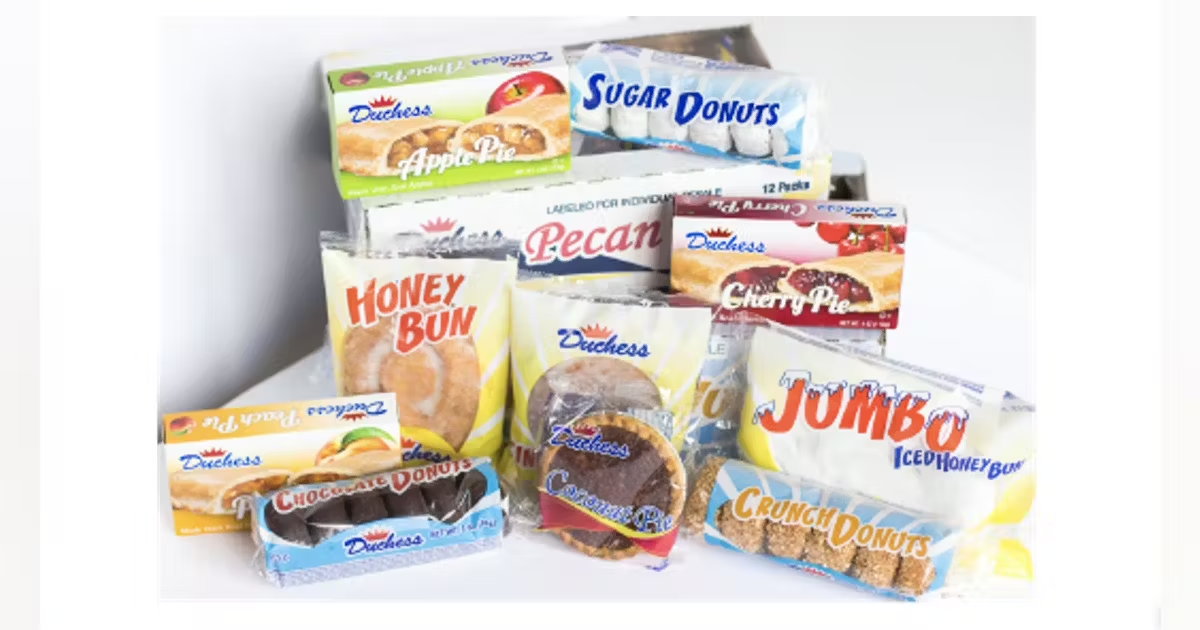
A good example of a case study on the development of legacy brands is Carolina Foods Incorporated, which was established in 1934 under the name Duchess, famous due to its honey buns and doughnuts. What began as sandwiches prepared by Vernon Scarborough in his basement to serve textile workers has since become a Charlotte-based bakery empire struggling to find its place in an Instagram-driven, keto-curious universe, the hardest marketing challenge ever to millennials.
The Reality Check: Carolina Foods has crafted high-quality baked goods for over 90 years, using time-honored techniques and leading technology, but “time-honored techniques” is marketing-speak for “we’ve been doing this since your great-grandmother had a sweet tooth.”
Operating in an industry with 2,800 commercial bakeries generating $30 billion annually, where the 50 largest companies control 75% of revenue, Carolina Foods faces the classic David vs. Goliath scenario – except Goliath has better distribution networks and million-dollar marketing budgets.
The “Duchess” brand name suggests royalty, but honey buns occupy decidedly plebeian territory in the snack hierarchy. Carolina Foods must somehow elevate their core product from “gas station impulse buy” to “premium indulgence worth posting about.”
Smart legacy brands lean into their history rather than running from it. Carolina Foods can position Duchess honey buns as authentic comfort food in an era of artificial everything. Think “your grandmother’s recipe, perfected” rather than “industrial pastry product #47.”
Based in Charlotte’s trendy Southend district, Carolina Foods sits in prime territory for the “local business” narrative that millennials and Gen Z actually care about. As a “Large Wholesale Bakery located in the beautiful Southend of Charlotte, NC”, they can leverage regional pride and the “support local business” trend.
When lowering competitive advantage is based upon economies of scale, smaller players such as Carolina Foods must distinguish themselves based upon quality, craftsmanship and story as opposed to attempting to out-volume the larger players.
Rather than competing head-to-head with national brands in convenience stores, Carolina Foods could target specialty markets, food service, and regional chains where their “local bakery” story carries more weight.
Today’s consumers want authenticity, transparency, and Instagram-worthy experiences – none of which traditional honey buns naturally provide. Carolina Foods faces the challenge of making their products feel special in a market saturated with artisanal everything and wellness-focused alternatives.
How do you make a honey bun photogenic when everyone’s feed is full of acai bowls and matcha lattes? It requires creativity, humor, and probably some really good lighting.
Carolina Foods exemplifies several key marketing principles: the importance of brand positioning in crowded markets, the challenge of legacy brand evolution, and the power of local/regional marketing in an increasingly homogenized marketplace.
Their case demonstrates that successful marketing often requires choosing your battles wisely – you can’t be everything to everyone, especially when you’re competing against companies with vastly superior resources.
Analyzing complex brand positioning challenges like Carolina Foods’? StudyCreek offers valuable resources for students tackling competitive analysis and legacy brand marketing case studies.
Need comprehensive support with your marketing coursework and brand strategy analysis? DissertationHive provides expert academic assistance for students navigating challenging marketing concepts and competitive landscape analysis.
Sample Assignment:
After significant growth in 2013 when Hostess Baking, a major competitor, declared bankruptcy, Carolina Foods, Inc.’s CEO, Paul Scarborough, wanted to develop a strategy to maintain that level of growth for his family’s 80-year-old commercial bakery and its Duchess brand. Hostess brands were purchased by various other commercial bakeries, and the Twinkie, an iconic American snack cake, was back on the market. CFI’s Duchess family brand of baked sweet goods included honey buns, donuts and pies manufactured in the original factory in Charlotte, NC, and distributed to markets across the USA, Canada, Mexico and Puerto Rico.
Consumer tastes were changing: Snacking in general was increasing and consumers were increasingly focused on healthy, or at least healthier, snacks. Social media was changing the marketing landscape: Could honey buns, donuts and pies be sold on line? Baked sweet goods firms were steadily consolidating across the nation. At CFI, no new products had been introduced over the past twenty years, the company did not have any dedicated marketing personnel, and no marketing budget was allocated (a sales budget did exist). Students can apply numerous basic marketing principles and tools to analyze and choose a viable marketing strategy for CFI. What strategy should CFI pursue for growth?
Sample Answer:
Marketing Strategy for Carolina Foods, Inc.
Student Name
Professor’s Name
Course Title
Date
Carolina Foods, Inc. (CFI) is a family-owned commercial bakery, which has a long history of operation of 80 years and is struggling to maintain the growth since the bankruptcy and eventual rescue of Hostess Baking. Although CFI took advantage of the fact that Hostess was not in the market temporarily, the re-entry by some well-known products such as Twinkies has increased competition. To maintain its growth, CFI will need to stay abreast with new consumer preferences, industry mergers, and new marketing mediums.
Increased demand of healthier snacks is one of the key factors that define the market. Consumers nowadays are more health conscious and they want alternatives that will provide them with indulgence and nutrition at the same time. The Duchess brand of CFI honey buns, donuts and pies has been running on popularism, yet the lack of product innovation in more than two decades would leave the brand in a disadvantageous situation. One of the suggestions is to add more products to the Duchess such as less sugar, whole grain, and portion-controlled foods and snacks that address the new snacking habits. This would allow CFI to retain its loyal customer base while attracting new segments concerned with health.
Of equal significance is the fact that the company does not have an integrated marketing unit. In the modern digital-first world, social media and e-commerce is a strong channel of reaching the consumers. Through marketing budget allocation and recruiting talented staff, CFI can use social media such as Instagram and TikTok to rebrand its products as something young people wish to experience and something modern but still somewhat nostalgic. It could also increase online sales to reach out to traditional retail distribution channel.
Lastly, CFI needs to think of strategic alliances or co-branding business to improve market share during consolidation in the baked goods sector. Partnering with coffee shops, convenience stores, or even health-centric brands would increase the visibility and diversify the sources of revenues.
To sum it up, product innovation, development of a formal marketing division and adoption of digital platforms are the key directions of sustainable growth of Carolina Foods as it seeks to meet changing consumer behavior.
Delivering a high-quality product at a reasonable price is not enough anymore.
That’s why we have developed 5 beneficial guarantees that will make your experience with our service enjoyable, easy, and safe.
You have to be 100% sure of the quality of your product to give a money-back guarantee. This describes us perfectly. Make sure that this guarantee is totally transparent.
Read moreEach paper is composed from scratch, according to your instructions. It is then checked by our plagiarism-detection software. There is no gap where plagiarism could squeeze in.
Read moreThanks to our free revisions, there is no way for you to be unsatisfied. We will work on your paper until you are completely happy with the result.
Read moreYour email is safe, as we store it according to international data protection rules. Your bank details are secure, as we use only reliable payment systems.
Read moreBy sending us your money, you buy the service we provide. Check out our terms and conditions if you prefer business talks to be laid out in official language.
Read more